Perplexity vs ChatGPT Search vs Google AI Mode — Which AI Search Should You Use?
Perplexity, ChatGPT Search, and Google AI Mode compared side by side — search accuracy, source citations, ad policies, and pricing. Find which AI search tool fits your workflow.
April 2026 · AI Comparison
Google now answers with AI before showing links. ChatGPT has built-in search. Perplexity was built as an “AI search engine” from day one. Suddenly, there are three places to search.
But the three services do subtly different things. Perplexity shows sources alongside every answer. ChatGPT generates answers first and searches as a backup. Google AI Mode layers an AI summary on top of traditional search.
“Which one should I use?” depends on what you’re looking for. Here’s a comparison covering accuracy, citations, ads, and pricing.
– Perplexity: Source-first search, numbered inline citations, ad-free
– ChatGPT Search: Generation-first, ads introduced ($60 CPM), 800M monthly users
– Google AI Mode: AI layer on existing search, ads in 25% of responses
– Verification: Perplexity. Creation: ChatGPT. Speed: Google.
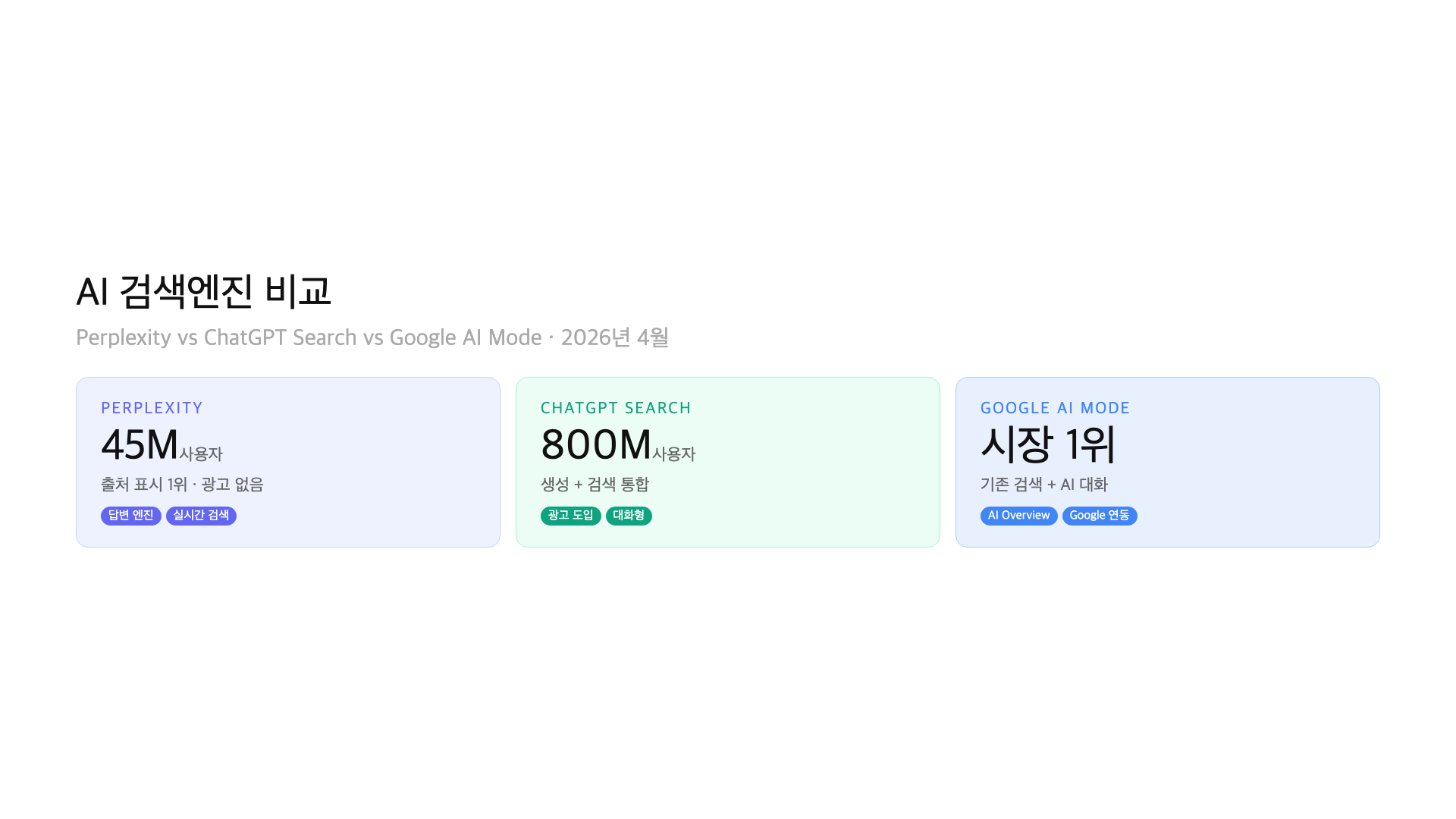
Three AI Search Engines — What’s Different?
Ask the same question to all three and you’ll get different answers. The reason is their fundamental approaches differ.
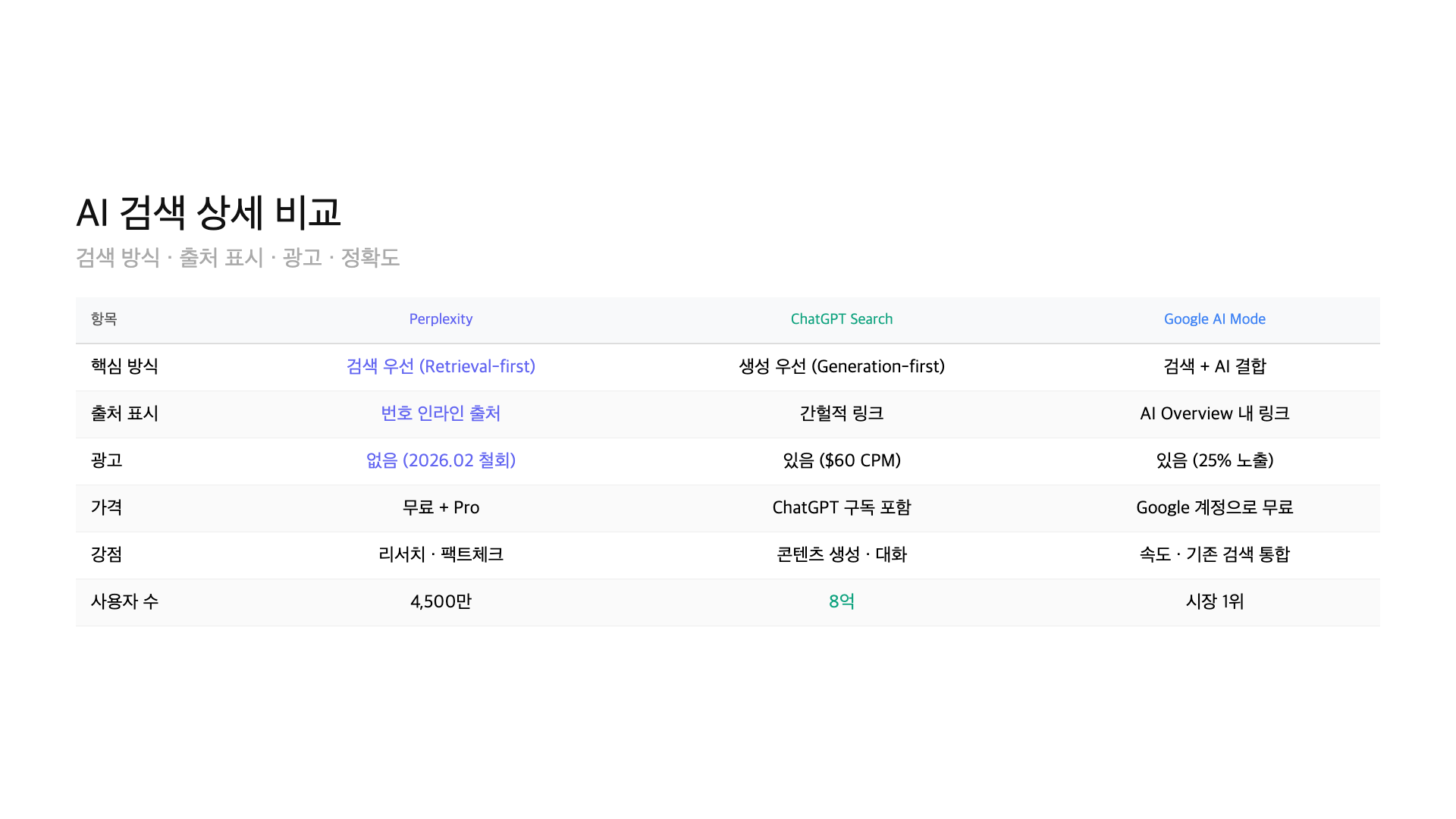
| Feature | Perplexity | ChatGPT Search | Google AI Mode |
|---|---|---|---|
| Approach | Search → Answer | Answer → Search assist | Search + AI summary |
| Citations | Numbered inline | Bottom links | Side links |
| Monthly Users | 45M | 800M | Undisclosed (90%+ search) |
| Ads | None (dropped Feb 2026) | Yes ($60 CPM) | Yes (25% of responses) |
| Strength | Research / fact-check | Content creation | Speed / convenience |
Perplexity is “retrieval-first.” It scans the web first, then builds answers from what it found. Every statement has a source number. ChatGPT is “generation-first.” The AI generates an answer first and uses search to supplement. Google AI Mode layers an AI summary on top of existing search results.
This matters because “search then answer” is strong on accuracy, while “answer then search” is strong on creativity. Google took the middle road with speed.
Perplexity — Search First, Then Answer
Perplexity calls itself an “answer engine.” Ask a question and it scans the web in real time, then presents a summary with numbered inline citations.
Its biggest strength is source transparency. Ask “What’s new in GPT-5.4 Thinking?” and the answer comes with [1], [2], [3] inline citations. Click any to go directly to the source. For academic research, fact-checking, and technical investigation, this is decisive.
Perplexity has 45 million users — small compared to ChatGPT’s 800 million, but growing fast. In February 2026, it dropped ads entirely and is targeting $500 million in subscription revenue. The “ad-free search” positioning is now locked in.
The free plan covers basic search well. Pro ($20/month) adds more precise search, file uploads, and advanced model access. The key differentiator: no ads even for free users.
ChatGPT Search — Answer First, Then Search
ChatGPT Search is integrated directly into ChatGPT. When current information is needed during a conversation, it automatically searches the web. No separate app — it works inside ChatGPT.
With 800 million monthly active users, ChatGPT has the largest user base among AI-native search tools. Google still dominates overall search, but in AI-powered search, ChatGPT is ahead by user count.
The fundamental difference from Perplexity is direction. Perplexity says “I’ll search and tell you.” ChatGPT says “I’ll create an answer — and search if needed.” Search is the supporting feature.
Where ChatGPT Search truly shines is when you need to create something from search results. “Search for the latest AI news and draft a blog post” — ChatGPT handles this better than Perplexity because search and generation happen in one step.
Google AI Mode — AI Layered on Traditional Search
Google AI Mode is a conversational AI tab within Google Search. When you search, an AI summary appears above the traditional link list, and you can ask follow-up questions. Since Google already handles 90%+ of all search, adding AI to it has massive reach.
The strength is speed and convenience. No separate app, no new account — just search on Google like you always have. Zero habit change required.
AI Overview (the AI summary at the top of search results) shows ads alongside 25% of responses. Given Google’s $175 billion annual search ad business, ads in AI answers were inevitable. This is the sharpest contrast with Perplexity.
| Feature | Perplexity | ChatGPT Search | Google AI Mode |
|---|---|---|---|
| Source Transparency | Best | Moderate | Moderate |
| Content Creation | Moderate | Best | Limited |
| Speed | Fast | Moderate | Fastest |
| Follow-ups | Supported | Conversational | Supported |
| Barrier to Entry | Sign-up needed | ChatGPT account | None |
Google AI Mode’s weakness is depth. It’s great for quick fact-checking, but digging deep into complex topics falls short of Perplexity or ChatGPT. AI summaries can also be inaccurate — for important information, clicking through to the source links is still the safe move.
Ads and Business Models Compared
The quality of AI search is directly tied to its business model. Ad-supported services may favor advertiser-friendly answers, while subscription-based services can prioritize user needs.
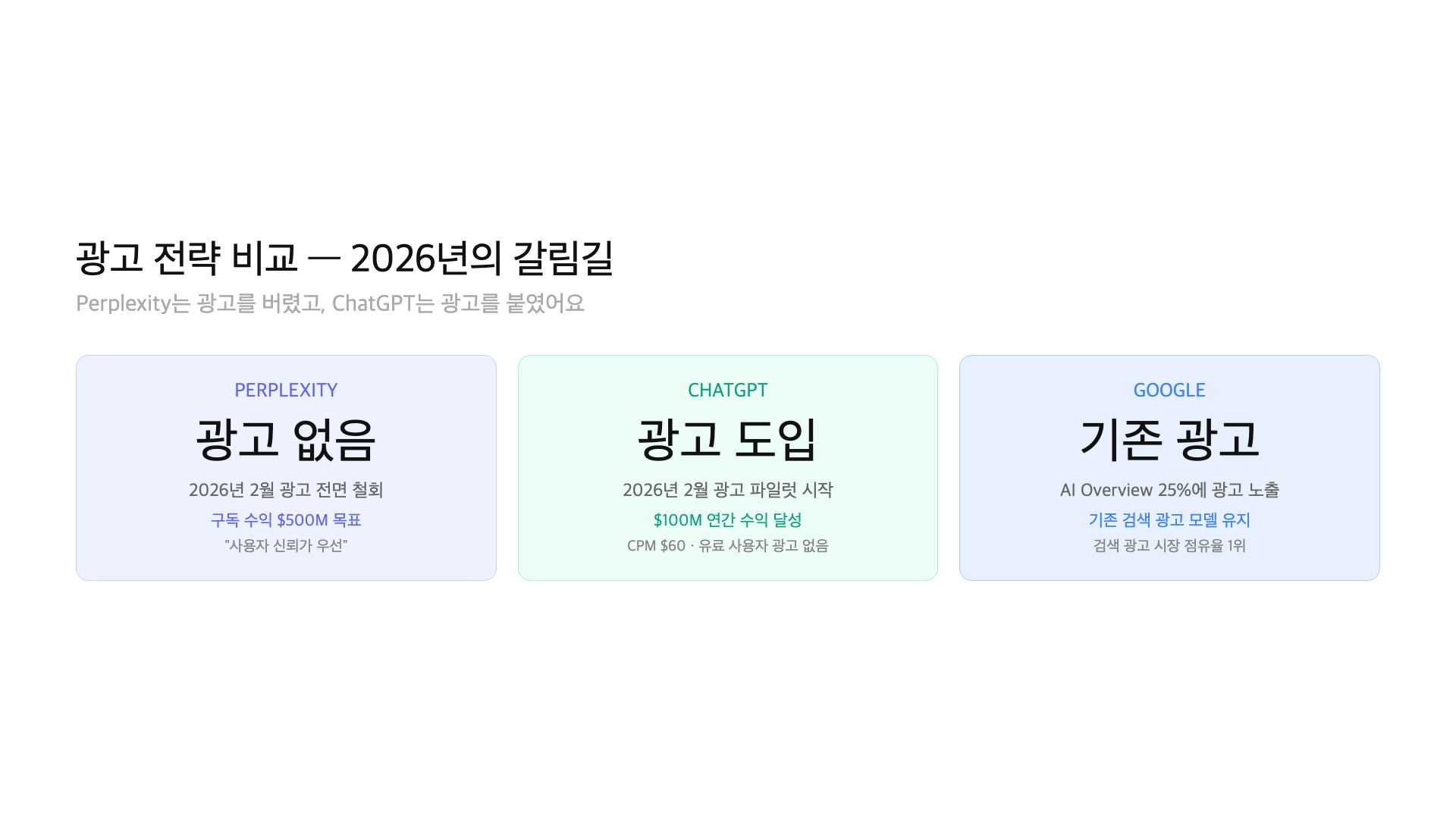
Perplexity removed ads entirely in February 2026. It’s targeting $500 million in subscription revenue. “Our answers have no ads” is its core differentiator.
ChatGPT Search went the opposite direction, introducing ads in February 2026 at $60 CPM. Annualized revenue is estimated at $100 million. Ads primarily appear for free users.
Google AI Mode extends its existing search ad business. Ads appear alongside 25% of AI Overview responses. With Google’s search ad revenue at $175 billion annually, this was inevitable.
If you want ad-free search with transparent sources, Perplexity is the only option. ChatGPT and Google have ads, but paid tiers reduce or eliminate them.
Recommendations by Search Purpose
Each service excels in different areas, so there’s no single “best.” It depends on what you’re searching for.
| Search Purpose | Best Pick | Why |
|---|---|---|
| Research / Investigation | Perplexity | Transparent sources, easy to verify |
| Fact-checking | Perplexity | Inline citations link to originals |
| Blog / Email Drafting | ChatGPT | Search + generation in one step |
| Code Search / Debugging | ChatGPT | Code execution + explanation |
| Quick Fact Lookup | Google AI Mode | Fastest, zero friction |
| Weather / Exchange Rates / News | Google AI Mode | Real-time data integration |
| Product Comparison / Purchase | Perplexity | Ad-free, neutral answers |
For research: Perplexity, no question. Sources are immediately visible, so verifying “is this true?” is fast. ChatGPT is best when you need to create something from what you found. Google is most convenient when you want a quick answer without leaving your existing workflow.
How to Combine All Three
The most effective approach is using all three based on the task. Many people already do this, whether they realize it or not.
Recommended workflow: Start with Perplexity to search and verify information. Once sources are confirmed, feed the data into ChatGPT to generate output (articles, code, analysis). Use Google for quick fact checks along the way.
Step 1 Perplexity → “AI search engine market share 2026”
→ Check sources [1][2][3], verify numbers
Step 2 ChatGPT → “Write a comparison analysis using the above data”
→ Generate content from verified data
Step 3 Google → “Perplexity monthly active users 2026”
→ Quick fact check
This combination works because each service does one thing best. Perplexity excels at search accuracy and sourcing. ChatGPT excels at generation. Assign each what it’s best at, and the output quality goes up.
Of course, switching between three services can be tedious. If you want to stick with one, choose by priority: research = Perplexity, productivity = ChatGPT, existing habits = Google.
FAQ
Q. Is Perplexity free to use?
Yes, the free plan covers basic search and answers. Pro is $20/month and adds more precise search, file uploads, and advanced model access. No ads on either tier — that’s the key differentiator.
Q. Which is more accurate — ChatGPT Search or Google AI Mode?
For factual search accuracy, Google AI Mode has the edge due to its unmatched web crawling coverage. ChatGPT Search is stronger at generating new answers from search results rather than pure retrieval. “Accuracy” means different things depending on your goal.
Q. Do AI search engines have ads?
ChatGPT Search introduced ads in February 2026 at $60 CPM. Google AI Mode shows ads alongside 25% of AI Overview responses. Perplexity dropped ads in February 2026 and focuses entirely on subscription revenue.
Q. Which AI search tool is best for research that needs source verification?
Perplexity, without question. Every answer includes numbered inline citations linking to sources. For academic research, fact-checking, or any work requiring verifiable evidence, it’s the clear winner.
Q. Should I use all three AI search tools?
That’s actually the optimal approach. Perplexity for search and verification, ChatGPT for content creation, Google for quick fact checks. Each excels in a different part of the workflow. If you want just one, pick based on your primary need.
Final Thoughts
The three AI search engines aren’t really competing — they’re dividing the work. Perplexity handles search and verification. ChatGPT handles creation and execution. Google handles speed and convenience.
One thing is clear: the era of “just Google it” is over. Try the combination of Perplexity for research, ChatGPT for creation, and Google for verification. The way you search might change for good.
Found this comparison helpful? Subscribe to GoCodeLab for more AI search insights.
This article was written in April 2026. Features and pricing may change — check official sites for the latest information.
GoCodeLab tests AI tools firsthand and shares honest comparisons. Subscribe for more AI coverage.