Anthropic Surpasses OpenAI in ARR — OpenAI's CRO Fires Back
Reports claimed Anthropic surpassed OpenAI with $30B ARR. OpenAI's CRO pushed back, saying Anthropic's figures were inflated by $8B. Ramp corporate card spending data was used to compare the two companies' actual AI market share.
On this page (11)
- $30B ARR — what happened on announcement day
- Denise Dresser's rebuttal — what she actually challenged
- The accounting fight — gross vs net
- What the Ramp data actually shows
- Claude Code's role in enterprise revenue
- Side-by-side — the current state
- Why this fight broke out now — IPOs and valuation
- Which one should you actually use?
- How to read numbers from private AI companies
- FAQ
- Final Take
April 2026 · AI News
Two companies went public with conflicting numbers on the same day. On April 7, 2026, Anthropic announced it had hit $30 billion ARR. Alongside it, the company closed a $30 billion Series G, pushing its post-money valuation to $380 billion.
The same day, OpenAI Chief Revenue Officer Denise Dresser sent an internal memo that promptly leaked, arguing Anthropic's number was overstated by roughly $8 billion. The disagreement wasn't about speculative pipeline deals. It was about how each company books cloud-partner sales — gross versus net — under GAAP. Ramp's corporate spending data provided a neutral reference point between the two claims.
The bottom line: this is less "who's bigger" and more "when you measure with the same ruler, who's ahead." The ruler differs by $8 billion.
- Anthropic: $30B ARR announcement + $30B Series G raise on April 7, 2026
- OpenAI CRO Denise Dresser: the figure is inflated by $8B — gross vs net on cloud billings
- OpenAI latest ARR: $25B (Q1 2026)
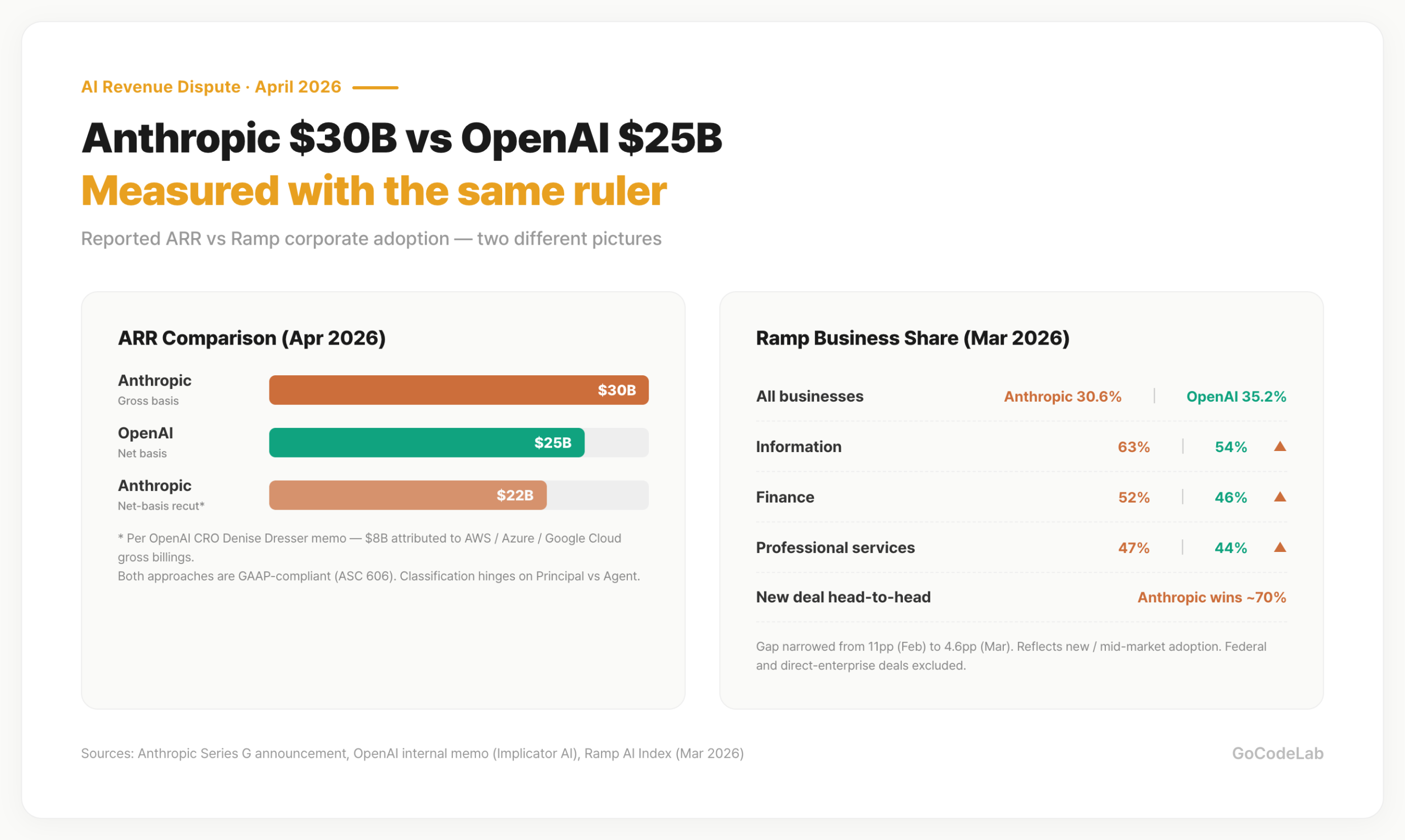
- Ramp March 2026: OpenAI 35.2%, Anthropic 30.6% — 4.6pp gap, down from 11pp in February
- Claude Code alone hit $2.5B ARR by February 2026
- Growth over the last 12 months: Anthropic ~10x / OpenAI ~3x
- $30B ARR — what happened on announcement day
- Denise Dresser's rebuttal — what she actually challenged
- The accounting fight — gross vs net
- What the Ramp data actually shows
- Claude Code's role in enterprise revenue
- Side-by-side — the current state
- Why this fight broke out now — IPOs and valuation
- Which one should you actually use?
- How to read numbers from private AI companies
$30B ARR — what happened on announcement day
On April 7, 2026, Anthropic announced three things at once. First, crossing $30B ARR. Second, a $30B Series G round at a $380B post-money valuation. Third, a 3.5-gigawatt TPU compute deal with Google and Broadcom. The timing wasn't accidental. Bundling the fundraise, revenue milestone, and infrastructure deal into a single news cycle was designed to lock in market perception in one move.
Anthropic was at $1B ARR in January 2025. Fifteen months later, it was thirty times that. The number of enterprise customers spending over $1M annually doubled from 500 to 1,000 in the two months immediately following Series G. That cohort of large contracts was the main engine behind the ARR spike.
Publishing specific figures was itself unusual. Private companies typically share these only with existing investors. Anthropic went public with hard numbers via blog posts and press releases — though it did not disclose methodology. That gap is where the rebuttal came in.
Denise Dresser's rebuttal — what she actually challenged
That Sunday, OpenAI CRO Denise Dresser sent an internal memo that leaked to the press the same day. The memo made three points. First, roughly $8B of Anthropic's $30B ARR is an accounting artifact. Second, OpenAI's own ARR stood at $25B as of Q1 2026. Third, on a comparable basis, Anthropic's real figure is closer to $22B.
What Dresser challenged was not speculative pipeline deals. The core issue was how Anthropic records revenue earned via AWS, Azure, and Google Cloud marketplaces. Anthropic books the gross billed amount. OpenAI books its Microsoft share net of the cloud provider's cut. The $8B figure is the approximate difference between the two methodologies.
Anthropic has not issued a formal rebuttal. In a subsequent interview, a company source stated that "every contract is committed revenue." Importantly, Anthropic's approach is not a GAAP violation. Multiple accounting analysts have pointed out, however, that when compared on OpenAI's basis, the two numbers aren't directly comparable.
The accounting fight — gross vs net
Whether revenue is booked gross or net is determined by ASC 606, the US revenue recognition standard. The test is whether the company is the "Principal" or "Agent" in the transaction. Principals recognize gross revenue; Agents recognize only their fee. Both outcomes are GAAP compliant.
Anthropic positions itself as the Principal on cloud-partner sales: it provides the model, sets pricing, and owns customer service responsibility. OpenAI's exclusive partnership with Microsoft gives it more room to treat itself as an Agent on portions of the relationship. The same type of transaction gets classified differently depending on corporate structure.
That's why direct comparison is hard. Each company is right by its own framework, but the two don't line up when placed side by side. "Anthropic surpassed OpenAI" is true on a gross basis. On a net basis, OpenAI still leads. Which number hits the market first tends to matter more than which is technically more rigorous.
A customer pays $100 for Claude API through AWS. AWS keeps $30 as a platform fee; $70 goes to Anthropic. Gross accounting recognizes the full $100 as revenue. Net accounting recognizes only $70. The heavier the reliance on large cloud marketplaces, the bigger the gap between the two methods.
What the Ramp data actually shows
Ramp aggregates corporate card spend from more than 50,000 US businesses in near real time. Unlike self-reported survey data, it reflects actual purchases. Ramp's March 2026 AI Index became the neutral reference point in this debate.
In March, OpenAI held 35.2% of businesses; Anthropic held 30.6%. The gap was 4.6 percentage points — down from 11 points in February. By new-purchase decisions, Anthropic is already winning about 70% of head-to-head matchups. If the trend holds, a crossover in customer count is likely within the next couple of months.
Industry-level data is already past the crossover point. In Information (63% vs 54%), Finance (52% vs 46%), and Professional Services (47% vs 44%), Anthropic leads OpenAI. These are the three most AI-intensive sectors. Total dollar spend still favors OpenAI, but the adoption curve — measured by count of paying businesses — has clearly tilted.
Ramp's customer base skews toward US startups and mid-market companies. Federal contracts and direct enterprise deals don't show up. The trend direction is reliable, but applying the absolute percentages to the whole market introduces error. Read it as "new/mid-market adoption momentum," not total market share.
Claude Code's role in enterprise revenue
A major driver of Anthropic's ARR climb was Claude Code. Launched in 2025, the agentic coding product hit $2.5B run-rate ARR as a standalone product by February 2026. Weekly active users doubled from January 1, 2026. A single product became the wedge into broader enterprise contracts.
The path is straightforward. A dev team adopts Claude Code. Repetitive work becomes partially automated. Team-level contracts expand to department level. Department contracts roll up into enterprise-wide licenses. Cursor, Windsurf, and Zed picking Claude as their default model only accelerated this route.
At the top of this funnel sits the $1M+ annual spend cohort. That group doubled from 500 to 1,000 in the two months post-Series G. Developer tools graduating into enterprise contracts is a playbook GitHub, Figma, and Notion already ran. What's different here is the speed.
Side-by-side — the current state
| Metric | Anthropic | OpenAI |
|---|---|---|
| Announced ARR (Apr 2026) | $30B (gross basis) | $25B (net basis) |
| Normalized estimate (same basis) | ~$22B (per OpenAI memo) | $25B |
| Trailing 12-month growth | ~10x | ~3x |
| Ramp business share (Mar 2026) | 30.6% (+6.3pp MoM) | 35.2% |
| $1M+ annual-spend customers | 1,000 (Apr 2026) | Not disclosed |
| Flagship product ARR | Claude Code $2.5B (Feb 2026) | ChatGPT Enterprise (undisclosed) |
| Latest round valuation | $380B (Series G, Apr 2026) | $500B (late 2025) |
| Key investors | Amazon, Google | Microsoft, SoftBank |
| Expected IPO timing | October 2026 (reported) | Q4 2026 (reported) |
Why this fight broke out now — IPOs and valuation
Both companies are reportedly targeting IPOs in the second half of 2026. In the run-up to an IPO, revenue headlines carry more weight than at any other time. If both list in the same window, investors will compare them directly. Whichever looks larger commands the higher multiple. An $8B difference can translate into tens of billions in valuation.
From Anthropic's angle, $30B on gross basis produces the headline "surpassed OpenAI." From OpenAI's angle, recut on net basis restores "still ahead." Neither is wrong by its own standard. The fight isn't over accounting accuracy — it's over who controls the headline.
The catch is that markets absorb headlines before footnotes. Retail investors and customer decision-makers don't read the revenue recognition notes. "Anthropic hits $30B, passes OpenAI" lands first and sticks. That's why OpenAI's CRO pushed a same-day response rather than waiting for a measured public statement.
Which one should you actually use?
Separately from the ARR fight, the practical question for users is which model to pick. The honest answer in 2026: single-vendor lock-in is usually inefficient. Split by workload.
| Use case | Recommended | Why |
|---|---|---|
| Coding agents / code review | Claude | Leads SWE-bench; native Claude Code tooling |
| Multimodal / image generation | OpenAI GPT-5 | Integrated image generation + analysis pipeline |
| Regulated industries (finance, health, legal) | Claude | Constitutional AI positioning + Ramp sector leadership |
| General chatbots / customer support | OpenAI | Mature plugin/connector ecosystem; higher total spend |
| Large document analysis | Claude | 1M context window, strong long-context accuracy |
| Cost-minimization priority | Case-by-case comparison | Haiku vs GPT-mini pricing moves frequently |
A practical workflow splits the traffic: coding on Claude, image work on GPT-5, low-cost bulk jobs on Haiku or GPT-mini. A router layer beats fixed single-model setups on both cost and performance. Claude Code, ChatGPT API, OpenRouter, and LiteLLM can all serve as that router.
How to read numbers from private AI companies
Anthropic and OpenAI are both private. Public companies must disclose audited financials quarterly. Private companies don't. Internal definitions can vary, and there's no external verification. What matters isn't the raw number — it's whether methodology is disclosed alongside it.
That said, announced figures aren't meaningless. Trend direction still reads clearly. "From $1B to $30B in 15 months" remains a rapid-growth story even if the real figure is $22B. Precision matters less than trajectory and competitive shifts.
Until IPO, it's safer to discount both sides' claims by about 30% and cross-check against third-party data (Ramp, Similarweb, cloud marketplace disclosures). Given that this debate is a preview of the H2 2026 IPO cycle, expect more exchanges like this as listing dates approach.
- Gross vs net basis — only meaningful when both sides apply the same one
- Cloud partner revenue inclusion — AWS / Azure / Google Cloud share
- Pipeline vs committed — signed contracts vs in-negotiation
- External audit — even within GAAP, interpretations differ
- Third-party cross-check — Ramp, Similarweb for neutral trend data
FAQ
Q. What is ARR?
ARR (Annual Recurring Revenue) is a forward-looking annual revenue estimate based on recurring contracts. If current contracts hold, how much comes in over the next year. It's the standard growth metric for SaaS and API businesses.
Q. What did OpenAI's CRO actually challenge?
Denise Dresser's internal memo targeted Anthropic's use of gross accounting on AWS, Azure, and Google Cloud marketplace sales. OpenAI books its Microsoft share net of the cloud provider's cut. That methodology difference is roughly $8B.
Q. Which accounting approach is correct, gross or net?
Both are US GAAP compliant. ASC 606 assigns gross or net based on whether the company acts as Principal or Agent. Anthropic positions itself as Principal; OpenAI's Microsoft partnership creates more room for Agent treatment. To compare companies, the same standard has to be applied.
Q. Can you trust Ramp's data?
Ramp aggregates real corporate card spend — not survey data. Trend direction is reliable. But Ramp's customer base skews US startup and mid-market, so federal deals and direct enterprise contracts don't show up. Read it as adoption momentum, not total-market share.
Q. How much did Claude Code contribute?
Claude Code hit $2.5B run-rate ARR as a standalone product in February 2026. Weekly active users doubled from January 1. Developer-tool adoption became the entry point for department-level, then enterprise-wide Claude licenses.
Final Take
This dispute came down to measuring the same reality with different rulers. Anthropic's $30B on gross basis recomputes to about $22B on OpenAI's basis. Neither is wrong inside its own framework. What the episode made clear is that comparable numbers require comparable methodology — and right now, neither company publishes enough detail for outsiders to do that cleanly.
Beyond the headline fight, the direction is what matters. Ramp's data shows Anthropic closing fast on enterprise adoption. OpenAI's same-day CRO memo is itself evidence that the competitive threat is real. The precise #1 will get settled after IPO filings. Until then, the honest read is: watch trajectory and product traction more than spot numbers.
· Anthropic Series G announcement — anthropic.com/news/series-g
· Bloomberg, Broadcom/Google TPU deal coverage — bloomberg.com
· OpenAI internal memo leak (Implicator AI) — implicator.ai
· Ramp AI Index — March 2026 — ramp.com/velocity/ai-index-march-2026
· Ramp AI Index — April 2026 — ramp.com/leading-indicators/april-2026-ai-index
· The Deep View, Anthropic $30B ARR coverage — thedeepview.com
real revenue in real projects
Figures in this article are sourced from Anthropic's own announcements, Ramp AI Index, Bloomberg and Implicator AI reporting. Both companies are private; no audited statements exist. Real ARR may differ from disclosed numbers. Not investment advice.
Last verified: April 2026.