OpenAI Shuts Down Sora — What Is Spud and Why It Matters
OpenAI is shutting down Sora on April 26. The next model codenamed Spud has finished pretraining, and the team renamed itself AGI Deployment. Here is what is happening and what comes next.
목차 (8)
March 31, 2026 · Trend
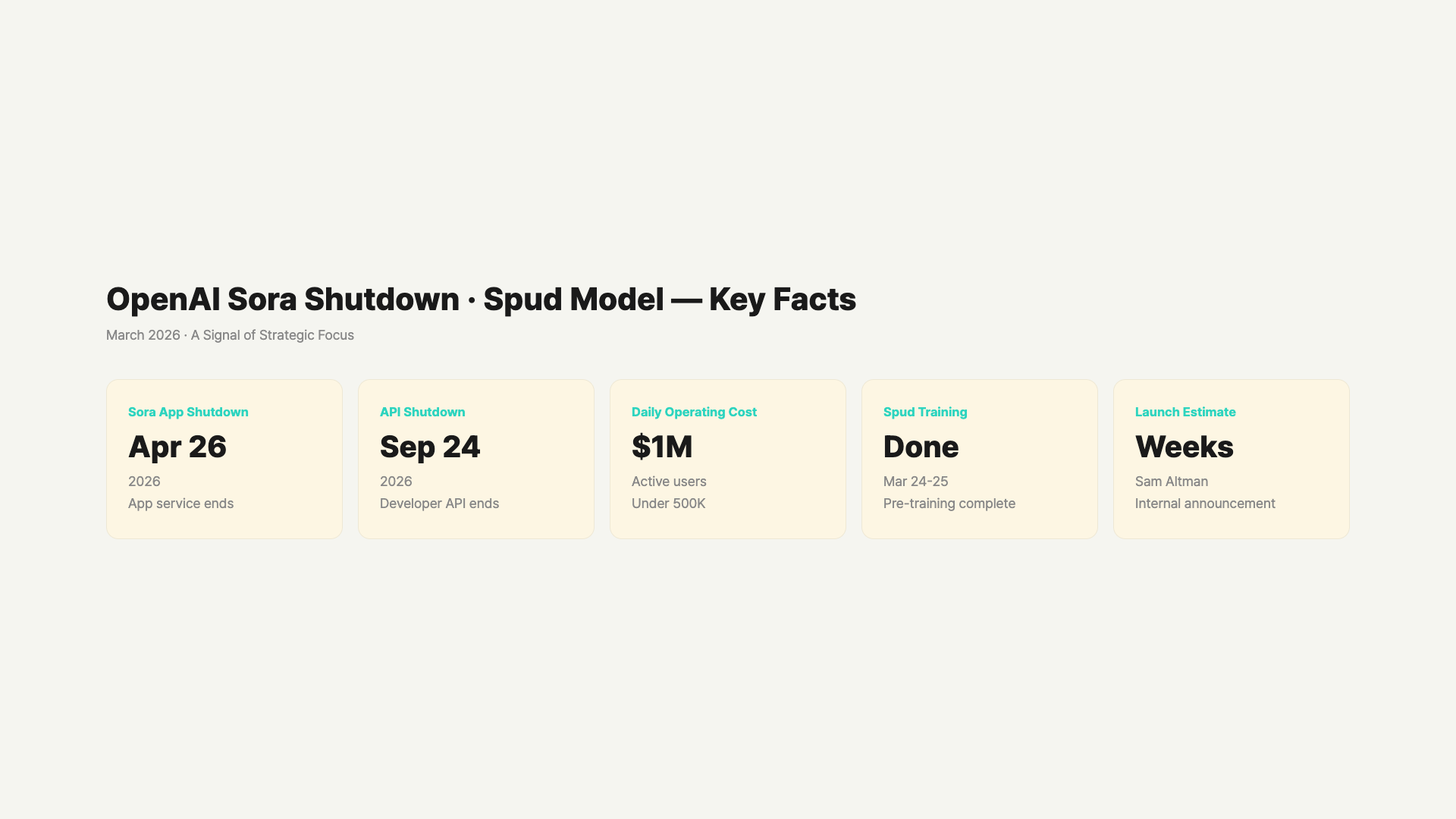
OpenAI announced it’s shutting down Sora. Less than 6 months after launch, the app will close on April 26. The API ends on September 24. “Wasn’t this supposed to be a hot AI video service?” is a fair question. But the reasons behind it are pretty shocking.
OpenAI just finished training their next model, internally called ‘Spud.’ Sam Altman told employees directly: “In a few weeks, a model that can accelerate the entire economy will arrive.” Shutting down Sora was a decision to redirect all computing resources to this model. They also renamed the product organization to ‘AGI Deployment.’ And the video data Sora accumulated is being repurposed for robot AI training.
In this article, we break down why Sora was shut down, what Spud is, and where OpenAI is heading. When you connect the pieces, an interesting picture emerges.
– Sora app closes April 26, API ends September 24
– $1M/day costs with active users dropping below 500K was decisive
– Sora video data is being repurposed for robot AI training
– Next model ‘Spud’ has completed pre-training, launch expected within weeks
– Sam Altman called it “a model that can accelerate the economy”
– OpenAI’s product organization has been renamed to ‘AGI Deployment’
Why Did Sora Get Shut Down After Just 6 Months?
Sora launched as a full app in late 2025. It secured a licensing deal with Disney and was considered the leader in AI video generation. It was integrated into ChatGPT, and an API was opened. There was definitely excitement at first.
But in reality, it was shaky from the start. Monthly downloads peaked at about 3.33 million in November 2025. After that, users steadily dropped, with active users falling below 500,000. Computing costs kept running. About $1 million per day was burning through servers. Generating 10 seconds of video cost around $1.30, and video generation requires far more computation than text.
The Disney partnership was quietly wound down too. What started as a major content deal ended as the service itself moved toward shutdown. Inside OpenAI, this was a question of “where do we allocate resources?” Shutting down an unprofitable service and redirecting those resources to Spud was the more rational call.
Sora app shutdown: April 26, 2026 / Sora API shutdown: September 24, 2026. If you’re currently using Sora, you should plan your backups and migration now.
What Exactly Is the ‘Spud’ Model?
‘Spud’ is an internal codename at OpenAI. It’s slang for potato. OpenAI tends to give their models humble codenames like this. We don’t yet know what name it’ll get at official launch — it could be GPT-5.5 or straight to GPT-6.
Here’s what we know so far. Pre-training was completed around March 24-25. It’s currently going through fine-tuning and safety testing. Sam Altman told employees in an internal memo that it could launch “within a few weeks.” A public announcement is likely sometime in April.
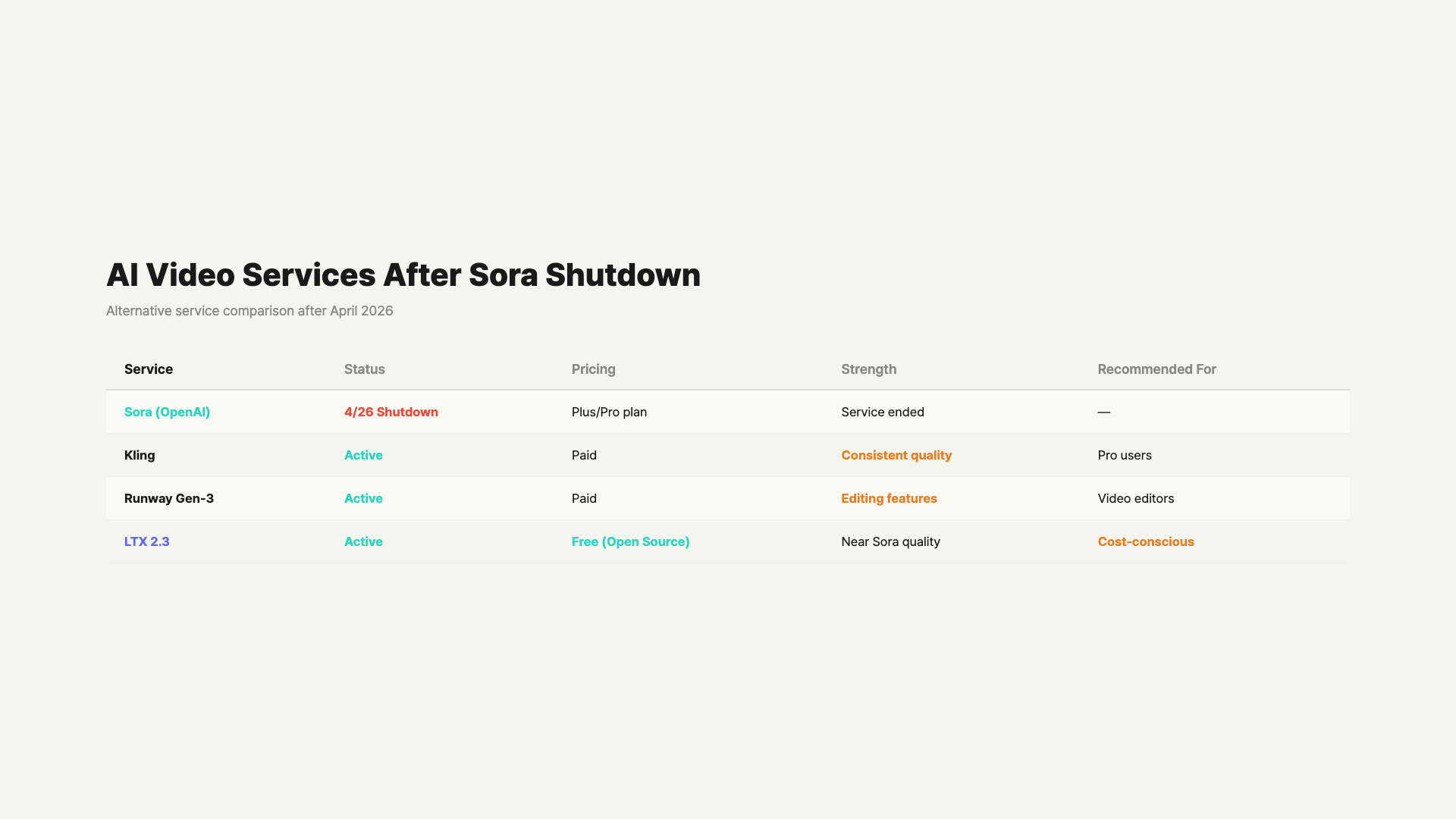
Internal assessments say it’s on a different level from existing models. It reportedly far surpasses previous models in coding, reasoning, and complex problem solving. Mathematician Terence Tao recently said “current AI mathematical reasoning is at the level of my graduate students.” With AI coding and reasoning tools getting rapidly stronger, the question is how far Spud will push this boundary.
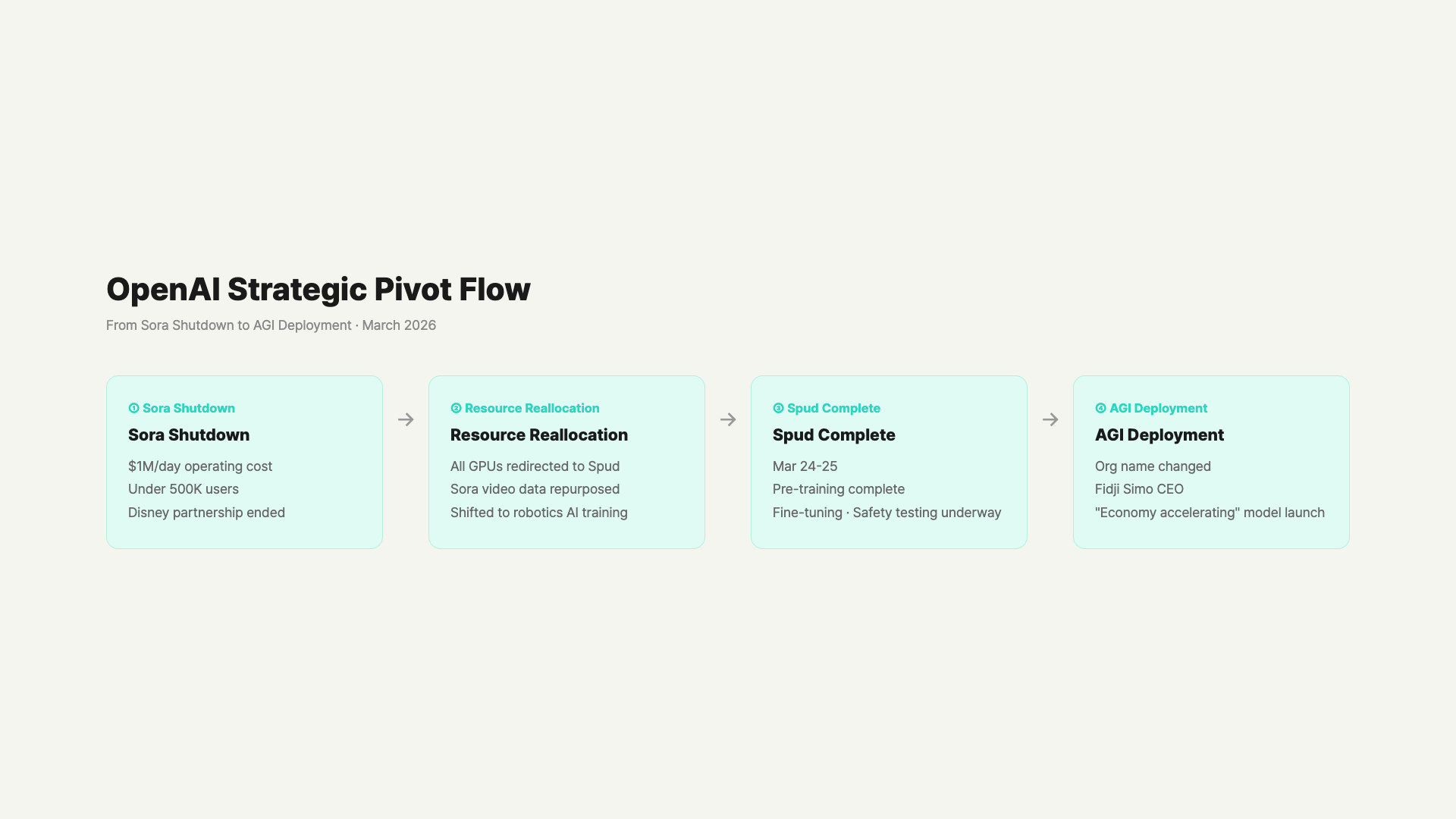
Sora Shutdown → Spud Focus → AGI Deployment Strategy Flow / GoCodeLab
“AGI Deployment” — Why Does a Name Change Matter?
OpenAI renamed its product organization from ‘Product Deployment Team’ to ‘AGI Deployment.’ This unit is led by Fidji Simo. On the surface it looks like rebranding, but the underlying message is different.
AGI stands for Artificial General Intelligence — AI with human-level or beyond intelligence. While OpenAI’s founding purpose was AGI development, this is the first time they’ve put the word in a product deployment team’s name. It’s not “the team that ships AI products” but “the team that opens the AGI era.” It reflects a shift in how the company sees itself.
The timing matters too. Shutting down Sora, completing Spud training, and renaming the organization — all three happened at the same time. Many read this as a signal that OpenAI is preparing something big. There’s a difference between a company that just renames things and one that declares “we’ve entered the phase of deploying AGI.” It deserves caution, but it’s hard to ignore.
Where Did Sora’s Data Go — From Video AI to Robot AI
Sora shutting down doesn’t mean the accumulated data disappears. OpenAI is repurposing the massive real-world video data Sora collected for robot AI training. Video data contains physical world movements, spatial relationships, and causal relationships — essential data for AI-controlled robotics.
This connects to OpenAI’s physical AI strategy. OpenAI has been steadily increasing its investment and research in robotics. Through Sora, they accumulated massive amounts of video data that can be used to train robot foundation models. It failed as a consumer service, but succeeded as a data pipeline.
From this perspective, Sora’s shutdown isn’t a simple failure. They ran a video AI consumer service, secured large-scale physical world data, then moved to a more important next step. Whether this was an intentional strategy or post-hoc rationalization of a failure is unknown. But OpenAI’s active use of this data is confirmed.
OpenAI’s Super App Strategy and Spud’s Role
OpenAI is planning a super app that combines ChatGPT, Codex, and a browser (Atlas) into one. Spud is likely to become the foundation model for this super app — a structure where one model handles text, code, browsing, and agent tasks in an integrated way.
The interesting part is the video capability. Sora failed as a standalone app, but it could return in an integrated form within the Spud-based ChatGPT super app. Users could generate videos within a ChatGPT conversation without opening a separate service — much more natural as a feature inside a super app than as a standalone product.
OpenAI’s strategy has changed. From running multiple separate services to concentrating everything into one powerful super app. Sora’s shutdown symbolizes this transition. It’s natural to expect OpenAI products to increasingly consolidate around ChatGPT.
| Item | Current Status |
|---|---|
| Model Codename | Spud (expected to be GPT-5.5 or GPT-6) |
| Pre-training Completed | March 24-25, 2026 |
| Expected Launch | Within April-May (weeks away) |
| Sora App Shutdown | April 26, 2026 |
| Sora API Shutdown | September 24, 2026 |
| Sora Data Repurposed | Redirected to physical AI (robot) training |
| Organizational Change | Product Deployment Team → AGI Deployment |
Remaining Uncertainties Before Launch
Not everything is optimistic. First, “within a few weeks” — Sam Altman’s timelines have historically been inaccurate. With GPT-4 and GPT-5, there were gaps between announced timelines and actual launches. The same pattern could repeat.
The safety testing period is a wild card. OpenAI has recently faced controversy around its safety team, with external criticism that safety priorities are declining. More powerful models take longer to evaluate. The actual launch could be delayed past May.
It doesn’t even have a name yet. Whether it’s GPT-5.5 or GPT-6 changes market expectations. The name OpenAI chooses is itself a marketing strategy. For now, remember the codename ‘Spud.’ Once it drops, we’ll be able to test it ourselves and see how much has changed.
FAQ
Q. What happens to videos I already made when Sora shuts down?
Even though the app service ends April 26, you can download your previously generated videos until then. The API remains available until September 24, so developers should plan their migration beforehand. We recommend backing up your creations before the official shutdown.
Q. Is OpenAI giving up on AI video generation entirely?
Not necessarily. They’re shutting down Sora as a standalone service, not abandoning video generation technology itself. When the Spud model launches, video capabilities will likely return in an integrated form within ChatGPT. The direction is folding it into the super app rather than keeping it as a separate product.
Q. Is Spud GPT-6 or GPT-5.5?
There’s no officially confirmed name. Multiple outlets including The Information speculate it could be GPT-5.5 or GPT-6. Which name OpenAI chooses is an internal marketing decision. At this point, understanding it by the codename ‘Spud’ is the most accurate.
Q. What does “accelerate the economy” specifically mean?
It’s a phrase Sam Altman used. The intended nuance is “a model at a level where AI contributes to actual economic growth beyond being a simple tool” — potentially including coding automation, complex decision-making support, and research acceleration. Of course, such claims need to be verified by actual performance after launch.
Q. What AI video services can I use instead of Sora right now?
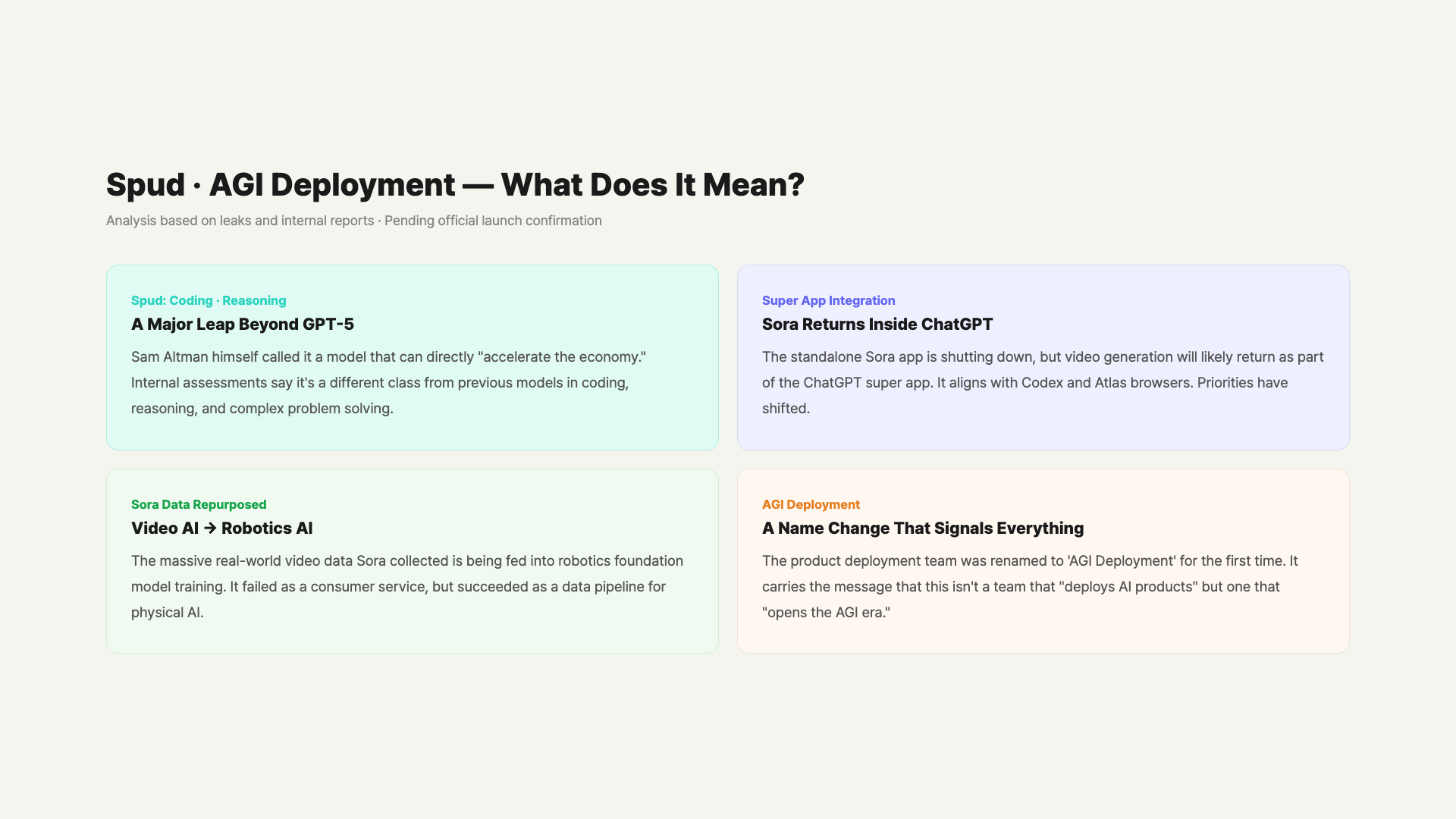
Kling, Runway Gen-3, and LTX 2.3 (open-source) are actively being used. LTX 2.3 is free and considered close to Sora in quality. If you can afford a paid option, Kling is currently the most stable. Check out GoCodeLab’s LTX 2.3 comparison article.
Q. What does it mean that Sora data is being used for robot AI training?
Video data contains physical world movements, spatial relationships, and causal relationships. Robots need this data to operate in the real world. While Sora didn’t generate revenue as a consumer service, it served the role of securing the large-scale video data needed for physical AI training. Whether this was planned from the beginning is unknown.
Wrap-Up
OpenAI shutting down Sora isn’t a failure — it’s strategic focus. Closing a service losing $1M/day and redirecting those resources to something more important. That “something more important” is Spud, and the team is ‘AGI Deployment.’ Sora’s data is flowing into robot AI.
Of course, there’s still more we don’t know than what we do. What level the Spud model actually reaches, when it launches, what it’ll be called. Sam Altman’s internal statements are intriguing, but you can only judge by actually using it. That’s the basic principle of the AI industry. When it drops, we’ll test it ourselves.
If you’ve been using Sora, start backing up your content right now. April 26 will be here sooner than you think.
When Spud launches, GoCodeLab will test it hands-on and share our findings immediately.
This article was written on March 31, 2026. It includes information based on internal reports before OpenAI’s official announcement. Details may change when Spud launches.
Related: Anthropic Accidentally Leaked Claude Mythos · We Tried LTX 2.3 — Free AI Video Generation · Cursor vs Windsurf vs OpenAI Codex Comparison