AI Trends6 min
What Is Agentic AI? — 2026’s Hottest AI Keyword, Simply Explained
Agentic AI explained for non-experts. The difference from chatbots, Galaxy S26 agentic features, OpenAI Operator, Claude Computer Use — all the latest 2026 information in one place.
March 7, 2026 · AI Trend Analysis
What’s different from chatbots, and why is everyone suddenly talking about agentic AI — here’s the explanation for non-experts.Agentic AI: Key Points
What Exactly Is Agentic AI?
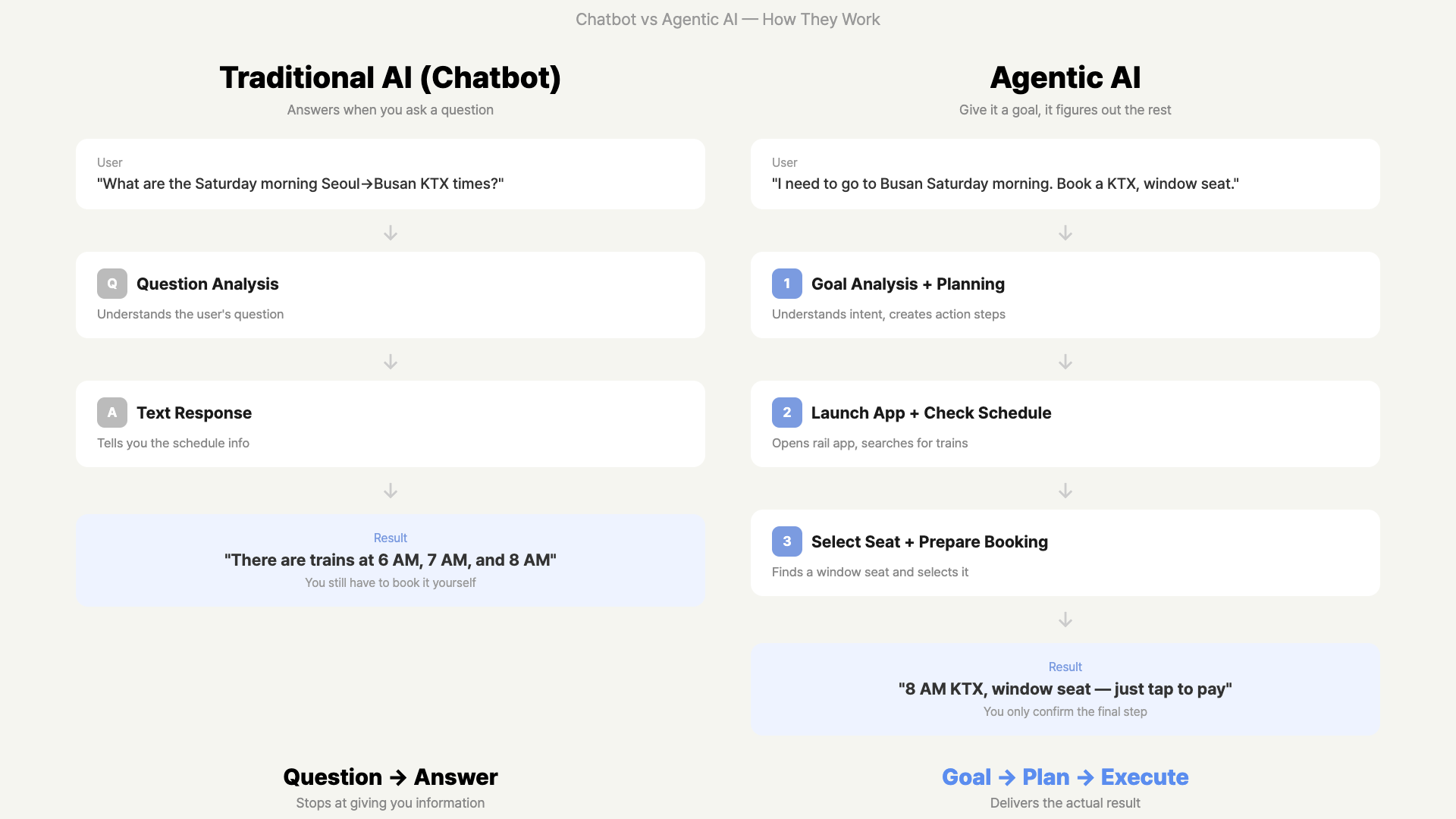
Lately, “Agentic AI” appears in AI news every single day. At CES 2026, MWC 2026, and Samsung Galaxy Unpacked — this term was everywhere. But when you actually ask people to explain it clearly, very few can. So let’s break it down simply. In one sentence: If traditional AI was a “secretary who answers when asked,” agentic AI is a “secretary who handles tasks on its own.” Here’s an example. Until now, you’d tell ChatGPT or Gemini:“Tell me the KTX schedule from Seoul to Busan”
The AI gives you the schedule, and that’s it. You have to make the booking yourself.
With agentic AI, you can say:
“I need to go to Busan this Saturday morning. Book a KTX for me. Window seat.”
Then the AI checks the schedule, picks a suitable train, opens the booking app, selects a window seat, and gets everything ready up to the payment step. You just press the final payment button.
That’s the core of “agentic.” AI goes beyond answering questions to actually taking action.
Chatbot vs Agentic AI — Side by Side
| Category | Traditional AI (Chatbot) | Agentic AI |
|---|---|---|
| How It Works | Question → Answer | Goal → Plan → Execute |
| User’s Role | Must give instructions each time | Just provide the goal |
| App Integration | Only gives answers (you execute) | Navigates across multiple apps |
| Memory | Resets after conversation ends | Remembers context and continues |
| Analogy | Search assistant | Personal secretary |
Why Did Agentic AI Suddenly Get Hot in 2026?
The concept of agentic AI isn’t actually new. But in 2026, every big tech company started using this term. There’s a reason.Samsung Galaxy S26 — “The First Agentic AI Phone”
In February 2026, Samsung unveiled the Galaxy S26 with the title “agentic AI phone.” It wasn’t just marketing — the device actually includes features where AI navigates between apps to complete tasks. The demo at Galaxy Unpacked was impressive. When a family group chat mentions ordering pizza, Gemini reads the conversation. It figures out what each person wants and builds a DoorDash cart. The human only needs to press the final payment button. Samsung combined three AI engines for this: Google Gemini (agentic tasks), Perplexity (search), and Samsung Bixby (on-device processing). Not one AI, but three working in designated roles.OpenAI, Google, Anthropic — All Building Agents
It’s not just smartphones. The big three in AI are all building “agent” services.| Company | Agent Service | Key Feature |
|---|---|---|
| OpenAI | Operator | AI directly controls web browsers. Strong for complex web task automation |
| Project Mariner | Handles 10 tasks simultaneously. Multitasks across web and mobile apps | |
| Anthropic | Claude Computer Use | Sees and operates computer screens directly. From code writing to file management |
What Can You Actually Experience Right Now?
To be honest, it’s not perfect yet. But as of March 2026, there are agentic AI features that regular people can try. Galaxy S26 users — Gemini links tasks across apps. Schedule something in a chat, and it auto-registers in Calendar and sets alarms. Supported apps are still limited, but the direction is clear. ChatGPT Plus users — Through Operator, you can delegate web tasks to AI. It handles repetitive work like filling online forms, comparison shopping across sites, and data collection. Claude users — With Computer Use, AI directly sees and operates your computer screen. You can delegate desktop tasks like file organization, code writing, and document editing.One-liner: The concept of “delegating work to AI” is becoming reality. It’s still early stage, but in 2026, it’s reached a level you can actually experience.
Who Benefits from This Change?
Office Workers with Repetitive Tasks
Those who create the same report daily, gather data from multiple sites, or organize emails. These “regular but tedious” tasks are the first target.People Who Wanted to Try AI but Found Prompts Difficult
The beauty of agentic AI is that you don’t need to write great prompts. Just describe the result you want. It’s moving toward a world where you can simply say “do this” without knowing prompt engineering.Heavy Smartphone Users
Starting with the Galaxy S26, we’ve entered an era where agentic AI comes built into smartphones. The experience of AI handling things across apps — without you manually opening and closing them — will keep growing.FAQ
Q. Is agentic AI different from ChatGPT? ChatGPT is gradually adding agentic AI features. Operator is the prime example. But the basic ChatGPT conversation mode is still “question-answer.” Think of agentic AI as adding “action” capabilities on top of models like ChatGPT. Q. Will agentic AI use my personal data freely? This is something everyone worries about. Current major services use a “human confirms important decisions” structure by default. For example, with payments or message sending, AI prepares everything, but the user presses the final button. However, since it’s still early, security standards aren’t fully established yet. Q. Do I need a paid subscription for agentic AI? In most cases, yes. OpenAI Operator requires ChatGPT Plus ($20/month) or higher, and Claude Computer Use is on paid plans. Galaxy S26’s Gemini agentic features come built-in, but advanced features may require Google One AI Premium. Q. Are there agentic AI services I can try right now? Yes. OpenAI’s Operator (ChatGPT Plus+), Anthropic’s Claude (Computer Use feature), and Google’s Gemini (on Galaxy S26 or Pixel 10) are the most accessible options. Some features are still English-heavy, and multilingual support varies by service. Q. How big will the agentic AI market get? The global AI agent market is projected to reach approximately $183 billion by 2033. The compound annual growth rate is 49.6%. It’s not just a trend — it’s the next phase of the AI industry.What to Watch Going Forward
Agentic AI is still in its early stages. Current features are at the “showing what’s possible” level. Seamless daily use will take more time. But the direction is clear. AI is shifting from a “tool that answers” to a “tool that works.” 2026 is the year this transition became visible. The one to watch is Apple. Samsung made the first move, but Apple hasn’t responded yet. Siri’s upgrade has been underwhelming. What Apple shows at WWDC this year could shape the second half of the year.We Actually Built Agentic AI
Lazy Developer EP.02
Tired of Checking Revenue for 12 Apps, So I Built a Dashboard
From App Store Connect API integration to JWT authentication struggles
Read →
Lazy Developer EP.03
I Delegated App Growth Strategy to AI
Keyword analysis, competitor monitoring, and weekly reports automated with Claude API
Read →
The era of AI doing your work is coming faster than you think. In the next post, we’ll put together a hands-on guide for trying agentic AI yourself.
Official Sources
Written March 7, 2026 · GoCodeLab AI Trend Analysis Series
This article is based on March 2026 information. AI services change rapidly, so check each service’s official site for the latest.