A Free Voice AI That Claims to Beat ElevenLabs — Mistral Voxtral TTS Compared
A Free Voice AI That Claims to Beat ElevenLabs — Mistral Voxtral TTS Compared
On this page (9)
March 29, 2026 · AI Comparison
Clone a voice from just a 3-second audio sample. And it’s free and open-source.
Mistral AI released its first TTS (text-to-speech) model, Voxtral TTS, on March 26. After making waves in the text AI market with Mistral Small 4, they’ve now entered the voice AI market. The model is available for free download on Hugging Face, with API pricing cheaper than ElevenLabs.
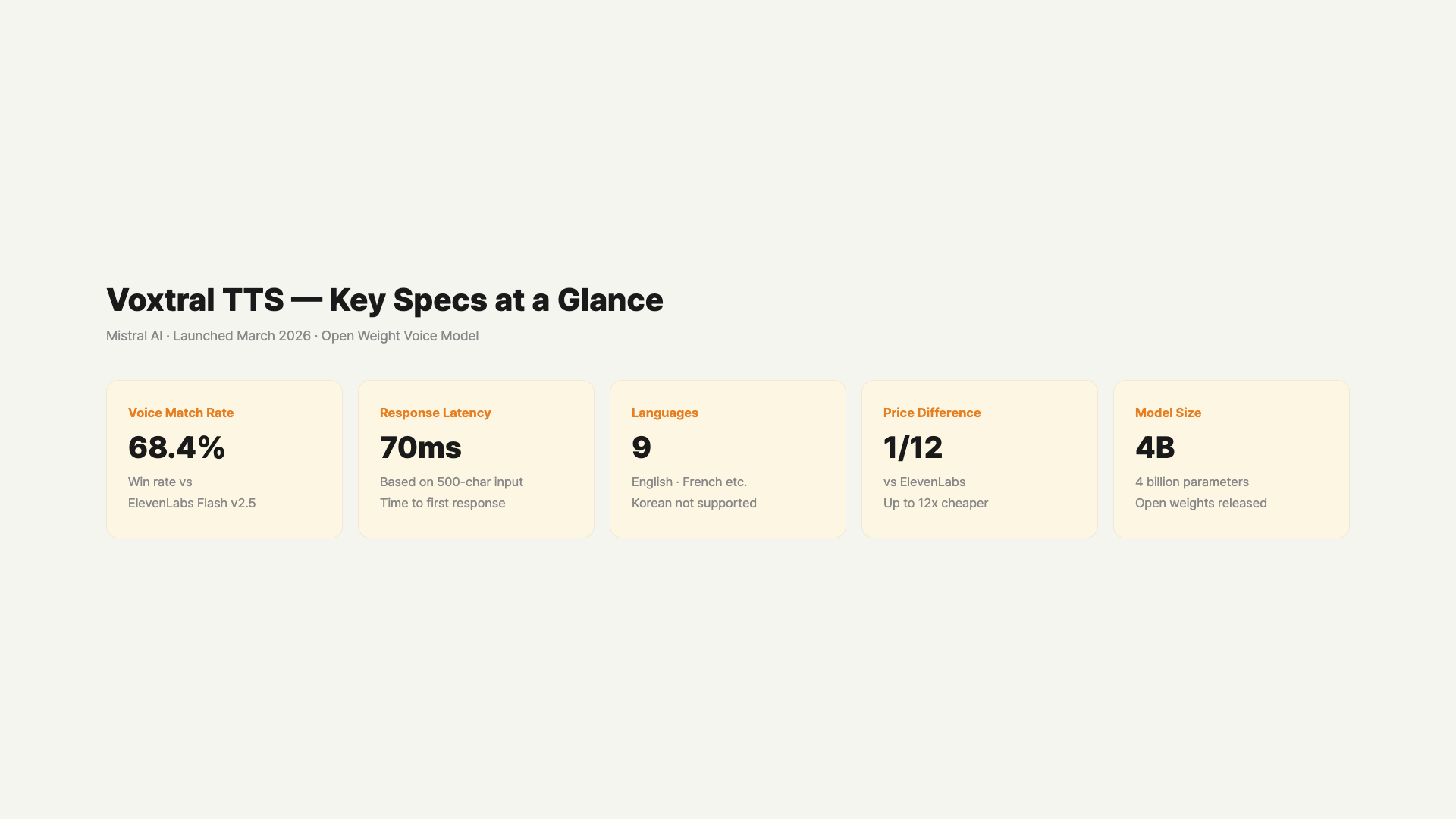
Mistral’s own human evaluation showed it sounds more natural than ElevenLabs Flash v2.5. This isn’t just a vague claim — it recorded a 68.4% win rate in zero-shot voice cloning comparisons. The numbers are quite specific, so we dug into the specs.
– Voxtral TTS is a 4B parameter open-weight TTS model (released March 26, 2026)
– Voice cloning from a 3-second audio sample (zero-shot voice cloning)
– 68.4% win rate vs ElevenLabs Flash v2.5 in zero-shot cloning (Mistral’s own evaluation)
– API price $0.016/1,000 characters — up to 12x cheaper than ElevenLabs Pro ($99/mo)
– 70ms latency, real-time streaming supported
– 9 languages supported (English, French, German, etc. — Korean not supported)
What Is Voxtral TTS?
Voxtral TTS is Mistral AI’s first voice generation model. At 4B (4 billion) parameters, it converts text into natural-sounding speech. It’s available on Hugging Face as mistralai/Voxtral-4B-TTS-2603.
Being open-weight is the key point. You can download the model weights and run it on your own server. The license is CC BY NC 4.0, so it’s free for non-commercial use. For commercial use, you need to go through the Mistral API at $0.016 per 1,000 characters.
The 70ms latency is also notable. It takes just 70ms to generate 10 seconds of audio from 500 characters of input. It supports real-time streaming and reportedly runs on laptops and mid-range GPUs. It comes with 20 preset voices and even supports emotion control — you can set tones like sad, happy, or serious.
Direct Comparison With ElevenLabs
ElevenLabs is currently the most widely used service in the TTS market, from YouTube creators to enterprise narration. Voxtral directly targeted ElevenLabs Flash v2.5 as its competitor.
Naturalness
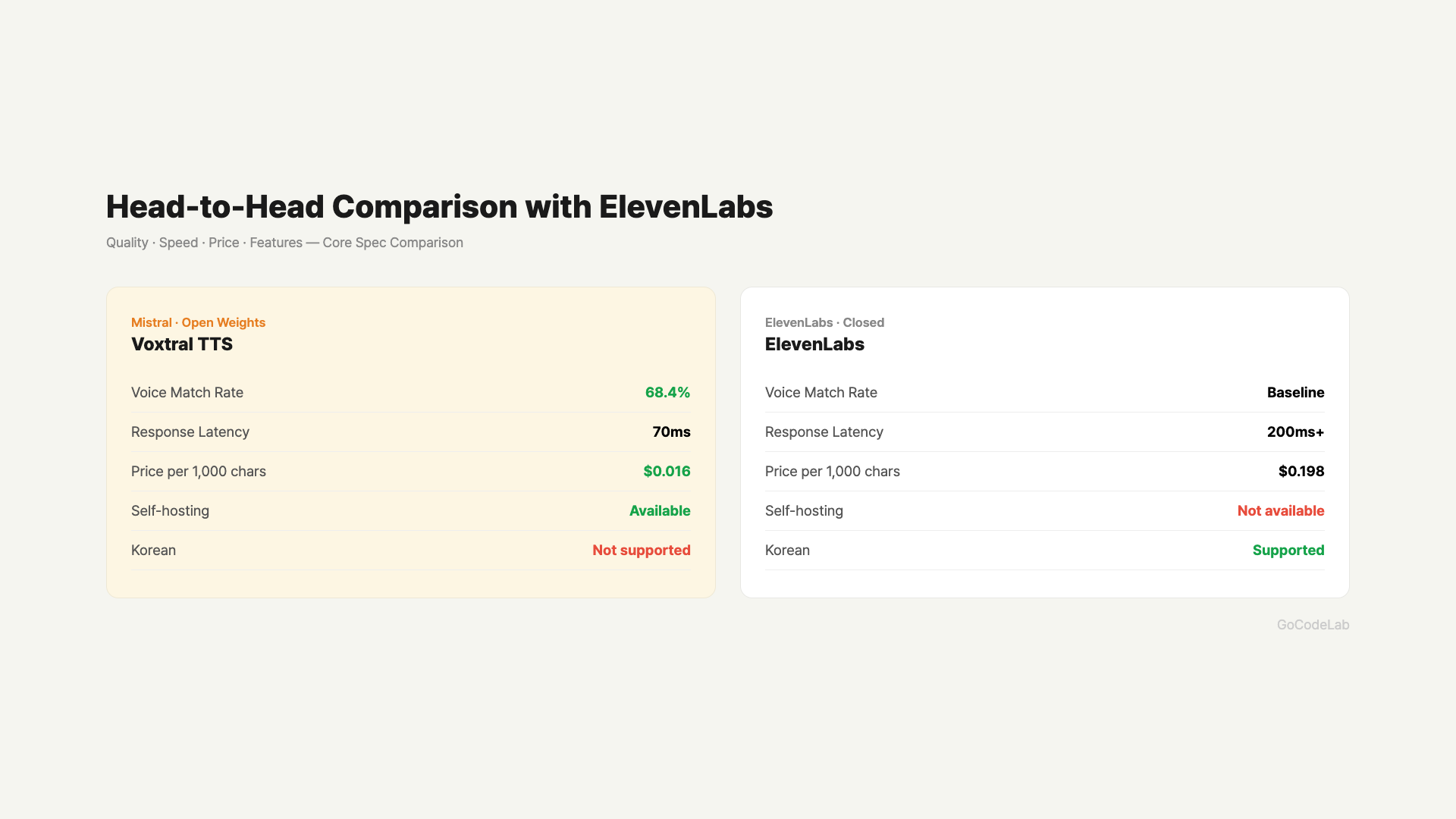
In human evaluations published by Mistral, Voxtral TTS recorded a 68.4% win rate against ElevenLabs Flash v2.5 in zero-shot voice cloning comparisons. It also showed comparable overall voice quality to ElevenLabs v3 (their premium model). Of course, since Mistral conducted the evaluation themselves, it’s hard to consider it 100% neutral. Independent third-party evaluations would be more trustworthy.
Feature Comparison
| Feature | Voxtral TTS | ElevenLabs |
|---|---|---|
| Free Tier | Model weights free (non-commercial) | 10,000 chars/month free |
| Self-hosted Deployment | Possible | Not possible |
| Languages Supported | 9 | 70+ |
| Korean | Not supported | Supported |
| Open Source | Open weights | Closed |
| Emotion Control | Supported | Supported |
| Dubbing/Translation Pipeline | None | Supported |
| Model Latency | 70ms | Similar level |
How Big Is the Price Gap? — Up to 12x Difference
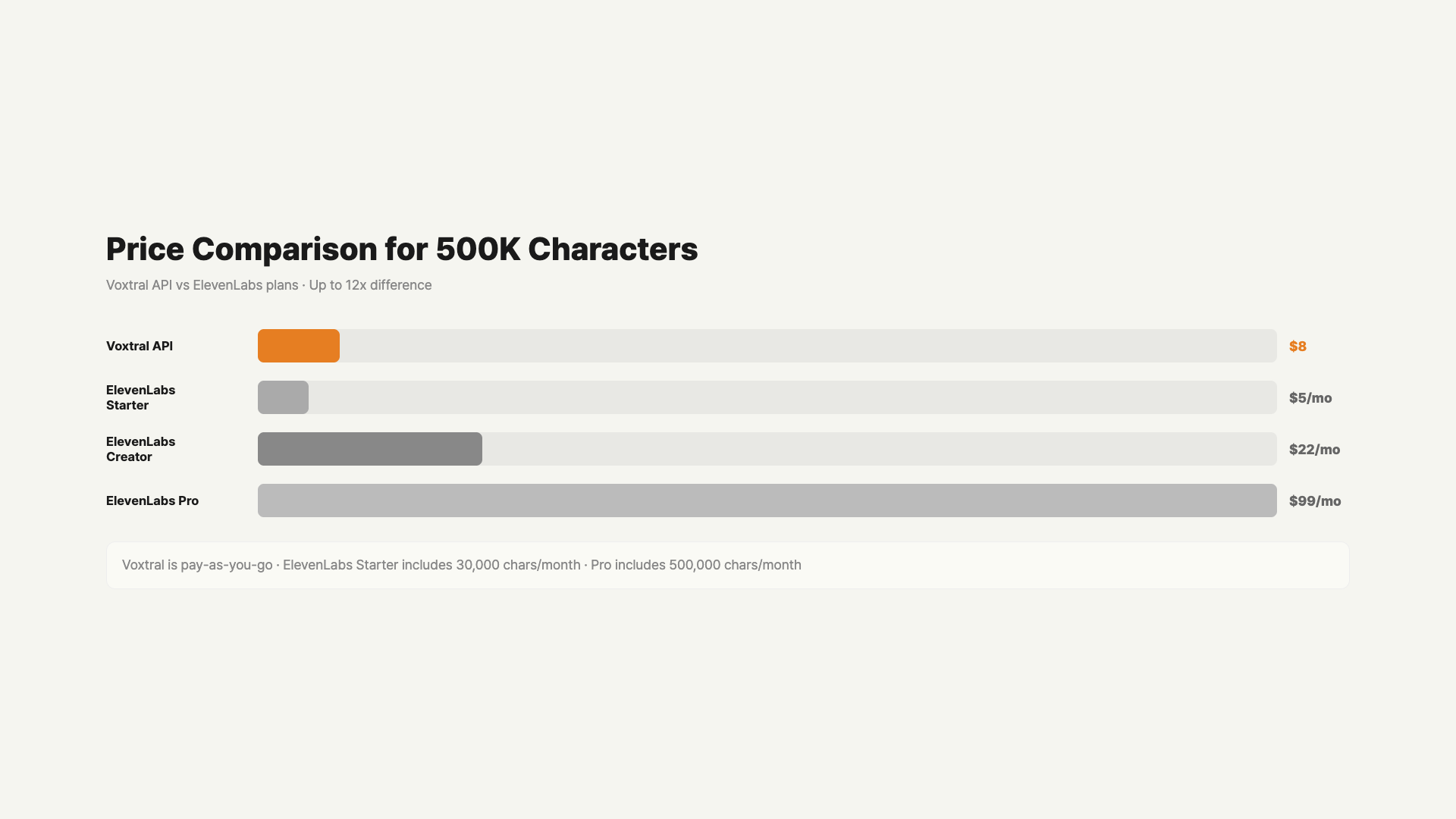
The price difference when choosing a TTS service is bigger than you might think. Comparing Voxtral API to ElevenLabs Pro produces surprising results.
| Plan | Monthly Cost | Character Allowance | Cost per 1,000 chars |
|---|---|---|---|
| Voxtral API (Pay-as-you-go) | Pay as you go | Unlimited | $0.016 |
| ElevenLabs Starter | $5 | 30,000 chars | $0.017 |
| ElevenLabs Creator | $22 | 100,000 chars | $0.022 |
| ElevenLabs Pro | $99 | 500,000 chars | $0.198 |
Processing 500,000 characters on ElevenLabs Pro costs $99. The same volume on Voxtral API costs $8. That’s about a 12x difference. Of course, ElevenLabs offers 70+ language support, a dubbing pipeline, and proven stability, so a pure price comparison isn’t entirely fair. But for producing English-only content at scale, the cost savings are clear.
Is It True That It Clones Voices From 3 Seconds?
One of Voxtral TTS’s standout features is zero-shot voice cloning. With just a 3-second audio sample, it captures the characteristics of that voice and reads new text in the same voice.
It also supports few-shot cloning. Longer samples produce more precise reproduction of timbre, intonation, and speaking rhythm. Mistral says it preserves the original voice’s personality, meaning it learns voice style, speed, and intonation patterns.
That said, don’t expect perfect cloning from a 3-second sample. This applies to any TTS model. Longer, cleaner samples produce better results. If you have a 10+ second sample recorded in a quiet environment, expect better output.
How Do You Use It in Practice?
There are two main ways to use Voxtral TTS.
Method 1 — Mistral API
Get an API key from la.mistral.ai and use it via HTTP requests. This is the fastest way to start without setting up a server. The price is $0.016 per 1,000 characters. Both Python SDK and REST API are supported. Mistral’s official docs have well-organized example code, so a developer can integrate it in 30 minutes.
Method 2 — Local Installation
Download the model from Hugging Face and run it on your own server or PC. Free for non-commercial use. Works smoothly with a GPU that has 8GB+ VRAM, and even runs (slowly) on modern laptop CPUs. Especially advantageous for enterprise environments where data can’t leave the premises.
It’s great for tasks that need English voice output, like YouTube narration, podcast script reading, or in-app English voice guidance. If you need Korean for your work, you’ll have to use a different service for now.
User Reactions and Early Launch Limitations
Developer community reaction was quite enthusiastic right after launch. Many enterprise developers especially noted “an open-weight TTS you can host yourself.” Medical, legal, and financial sectors where data sovereignty matters highly valued the local deployment option.
There were disappointments too. Early reports indicated inconsistent zero-shot voice cloning quality. Some voice samples worked well, while others showed noticeable differences from the original. This appears to stem from training data diversity limitations and will likely improve in future updates.
Another limitation is the lack of a Dubbing/Translation Pipeline like ElevenLabs offers. Tasks like dubbing an English podcast into Spanish or re-creating videos in multiple languages aren’t possible with Voxtral alone right now. Compared to ElevenLabs’ mature production pipeline, there’s still a gap to close.
No Korean Support? — An Honest Limitation
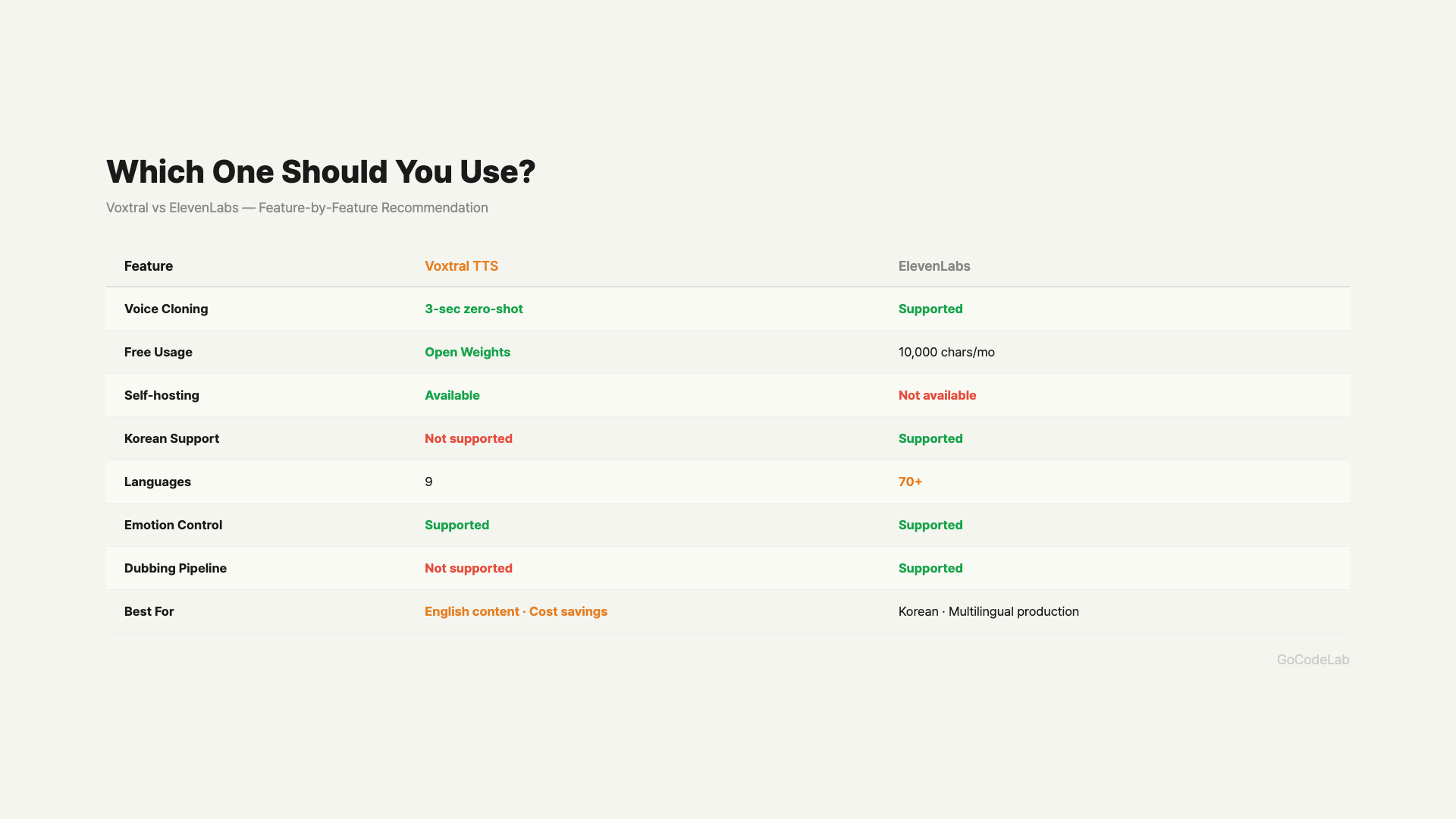
The lack of Korean support is a notable gap. The 9 languages currently supported by Voxtral TTS are English, French, German, Spanish, Dutch, Portuguese, Italian, Hindi, and Arabic. Asian languages like Korean, Japanese, and Chinese are all missing.
Mistral may add more languages in the future. However, the official roadmap hasn’t mentioned when Korean support might come. It’s hard to be confident it will be added anytime soon. If you need Korean TTS, you should use ElevenLabs (Korean supported), CLOVA Voice (Naver), or Google Cloud TTS.
If you work with a lot of English content, want to customize with open source, or want to run it on your own server, Voxtral is an attractive option. If Korean is your primary language, other services are the realistic choice for now.
ElevenLabs — Korean supported, from $5, voice cloning supported · CLOVA Voice — Naver service, strong domestic voice data, API available · Google Cloud TTS — Korean included among 50+ languages, Pay-as-you-go $4/100M chars
FAQ
Q. Is Voxtral TTS completely free?
Downloading the model weights for non-commercial use is free under the CC BY NC 4.0 license. For commercial use or convenient API access, you need to pay Mistral’s API rate ($0.016/1,000 chars). For freelancers or small projects, the free tier is enough for thorough testing.
Q. In what situations is Voxtral better than ElevenLabs?
If you create a lot of English voice content and want an open-source solution, Voxtral is a good choice. Being able to run it on your own server means data doesn’t leave your infrastructure, which can be a real advantage in enterprise settings. Local deployment is especially meaningful in industries like healthcare, legal, and finance where data security matters. On the other hand, if you need Korean or 30+ languages, or dubbing features, ElevenLabs is the better fit.
Q. When will Korean support be added?
Mistral hasn’t released an official roadmap yet. Korean is not among the current 9 supported languages. There’s a possibility it could be added, but the timeline is uncertain. If you need Korean, using other services alongside Voxtral is the realistic approach for now.
Q. Can I run Voxtral on a laptop?
Voxtral is relatively lightweight at 4B parameters. According to Mistral, it runs on regular laptops, mid-range desktop GPUs, and some high-performance mobile devices. With a GPU that has 8GB+ VRAM, real-time streaming works smoothly. It runs on CPU alone too, but may be slower.
Q. Could my voice be cloned and misused?
Being an open-weight model, complete control is difficult in practice. Mistral restricts misuse through the CC BY NC 4.0 license and usage policies. Cloning someone’s voice without their consent is a legal and ethical issue. Using your own cloned voice for content creation is fine, but unauthorized cloning of others’ voices should be avoided.
Wrap-Up
Voxtral TTS is Mistral’s first voice AI venture, entering an ElevenLabs-dominated market with the open-weight card. Three clear strengths: price competitiveness (up to 12x cheaper), low latency (70ms), and self-hosting capability. The 68.4% zero-shot cloning win rate is a self-evaluation, but hard to ignore.
However, it lacks Korean support, had voice cloning consistency issues at launch, and still doesn’t have polished features like ElevenLabs’ dubbing pipeline. Rather than replacing ElevenLabs in every scenario, Voxtral is a tool with strengths in specific use cases where “English voice, open source, and data sovereignty” matter.
If you’re a developer or creator who works extensively with English voice content, it’s definitely worth trying. Since it’s open source, there’s no cost to test it yourself.
At GoCodeLab, we try AI tools hands-on and share honest reviews. Subscribe to get notified whenever we publish new articles.
This article was written on March 29, 2026. Mistral Voxtral TTS is in its early stage and specs/pricing may change. Check the official Mistral documentation for the latest information.
Related: Mistral Small 4 Is Here · We Tried LTX 2.3 · MCP Protocol Surpasses 97 Million Installs