ChatGPT Free Users Will Now See Ads — OpenAI Ad Rollout Explained
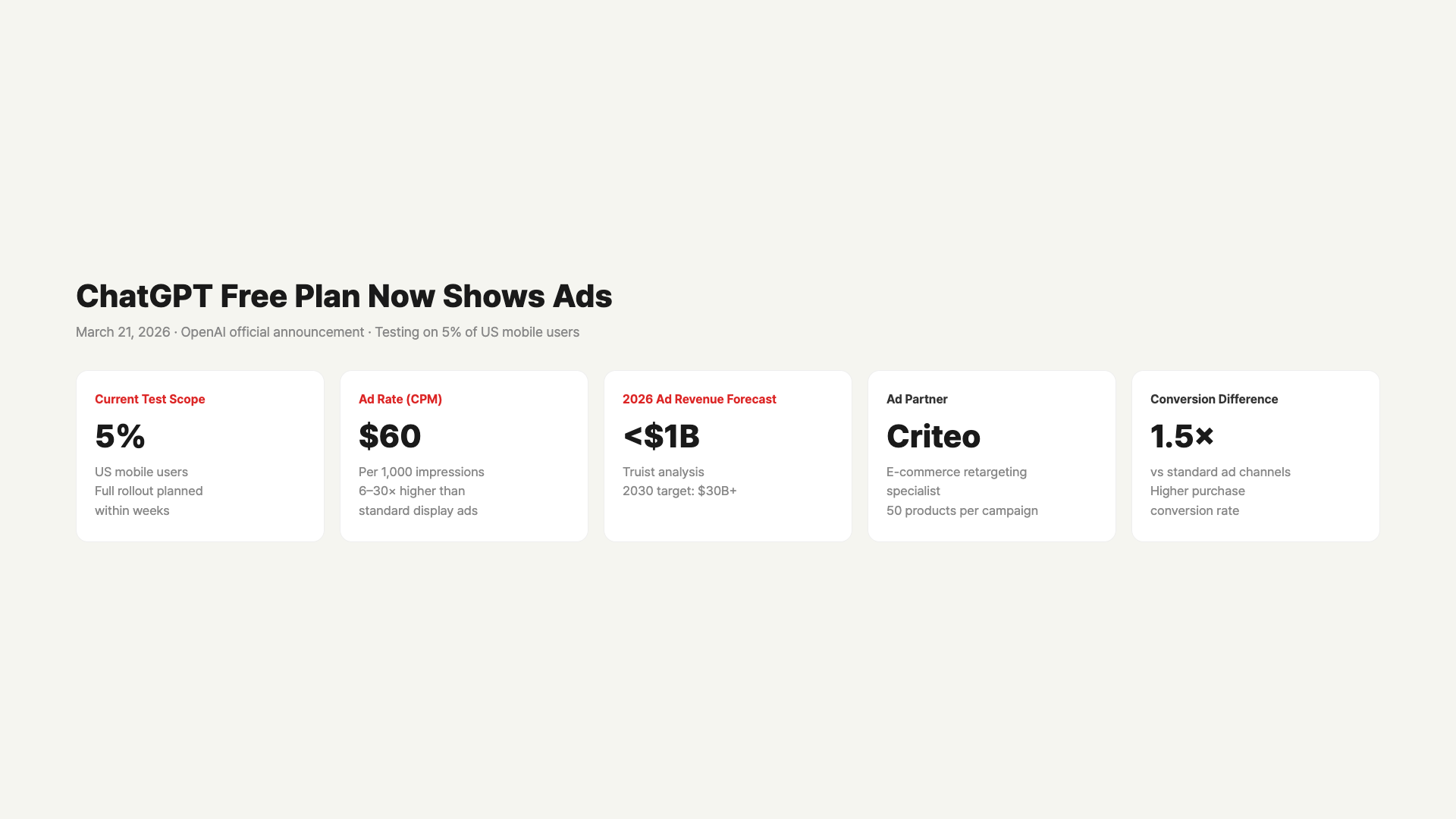
Ads are coming to ChatGPT's free plan. OpenAI officially announced on March 21, currently testing with 5% of US mobile users. What kinds of ads appear, where they show up, whether answers are affected, and what paid users get — everything you need to know.
March 24, 2026 · Trends
If you’re using ChatGPT for free, you’ll be seeing ads soon.
On March 21, OpenAI made it official. They’re starting to show ads to Free and low-cost (Go) plan users in the US. Right now it’s only being tested with about 5% of mobile users, but a full rollout is planned within weeks. The desktop version will follow, and with global expansion included, this will eventually reach users worldwide.
Some might think “ads in AI?” — but Google started with ads in search results too. YouTube, Instagram — they all launched ad-free and added ads during monetization. ChatGPT is following that same path. Let’s break down exactly what this announcement means, where and how ads appear, and whether your conversation data is used for ads.
– Ad testing started in March for ChatGPT Free/Go users (US)
– Ads appear in a separate area below the answer, marked “Sponsored”
– No impact on answer content (official OpenAI position)
– Pro, Business, Enterprise subscribers see no ads
– Ad partner is Criteo, fixed CPM of $60
– To avoid ads: reduce daily messages or switch to a paid plan
Why Are Ads Coming to ChatGPT?
It’s simple. Money.
OpenAI is providing GPT-4 level models to hundreds of millions of users for free every day. The cost is enormous. AI inference costs are on a completely different level from regular server operations. The GPU computation needed to process a single question is incomparably larger than a regular web search. Add model training, data center maintenance, and personnel costs, and OpenAI’s annual operating cost reaches billions of dollars.
No matter how many ChatGPT Plus ($20/month) subscribers there are, they alone can’t cover these costs. OpenAI reportedly recorded about $5 billion in losses in 2025 alone. They’ve been surviving on Microsoft’s massive investment and enterprise API revenue, but they needed a sustainable revenue model long-term. Ads were chosen as the answer.
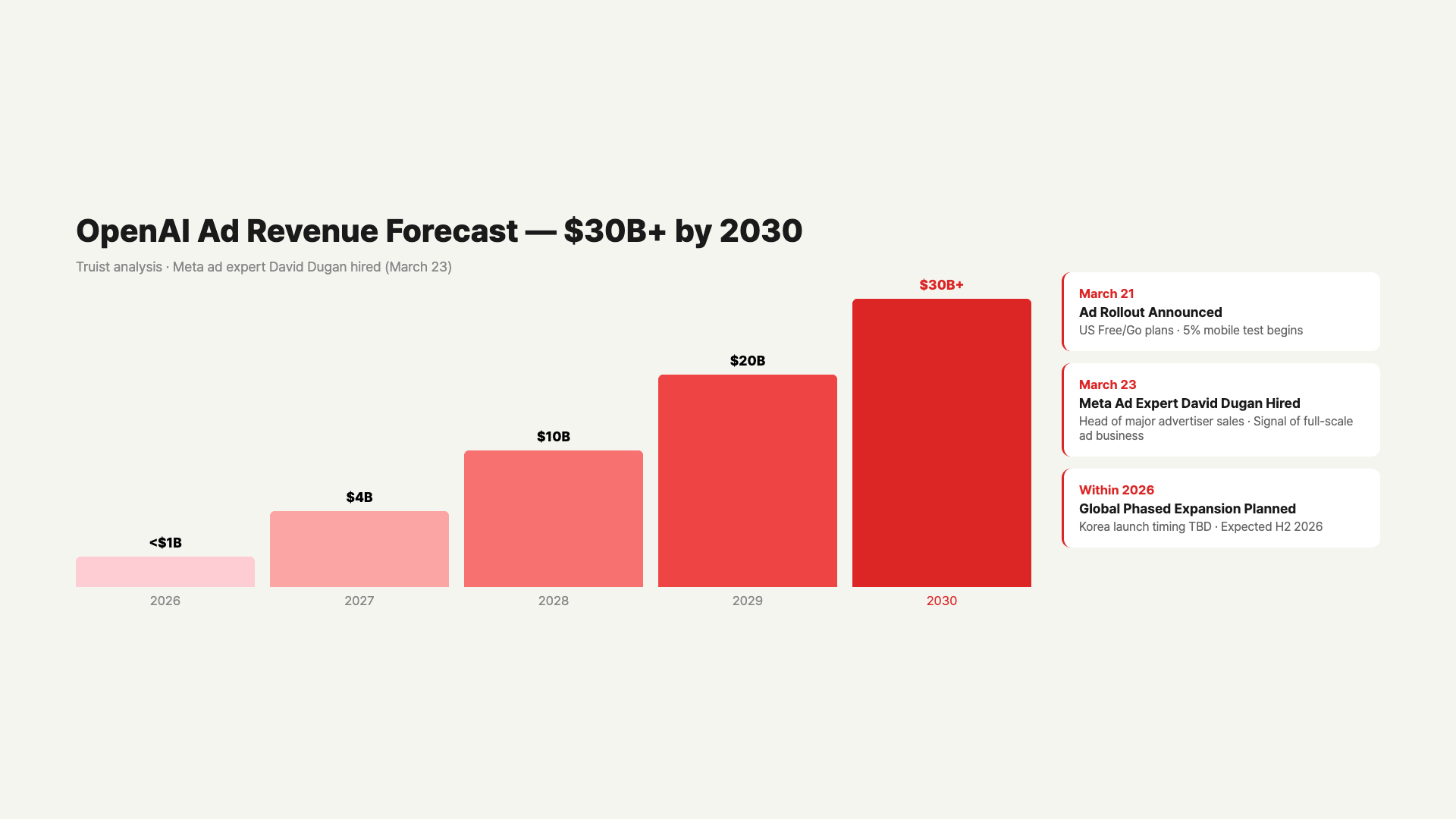
Industry analyst Truist estimates that OpenAI’s ad revenue will start under $1 billion this year (2026) but grow to over $30 billion by 2030. To put that in perspective, Google’s total ad revenue in 2025 was about $200 billion. The prediction is that OpenAI could reach 15% of that level. That’s a pretty big bet.
On March 23, they hired David Dugan, an advertising veteran from Meta. He managed relationships with major advertisers at Meta, and the intent to structurally grow the ad business is clear. When a tech company hires an ad executive, it reads as a signal that “serious ad monetization is in preparation.” This isn’t about simple banner ads — they’re looking at sophisticated targeting and major advertiser sales, just like Meta.
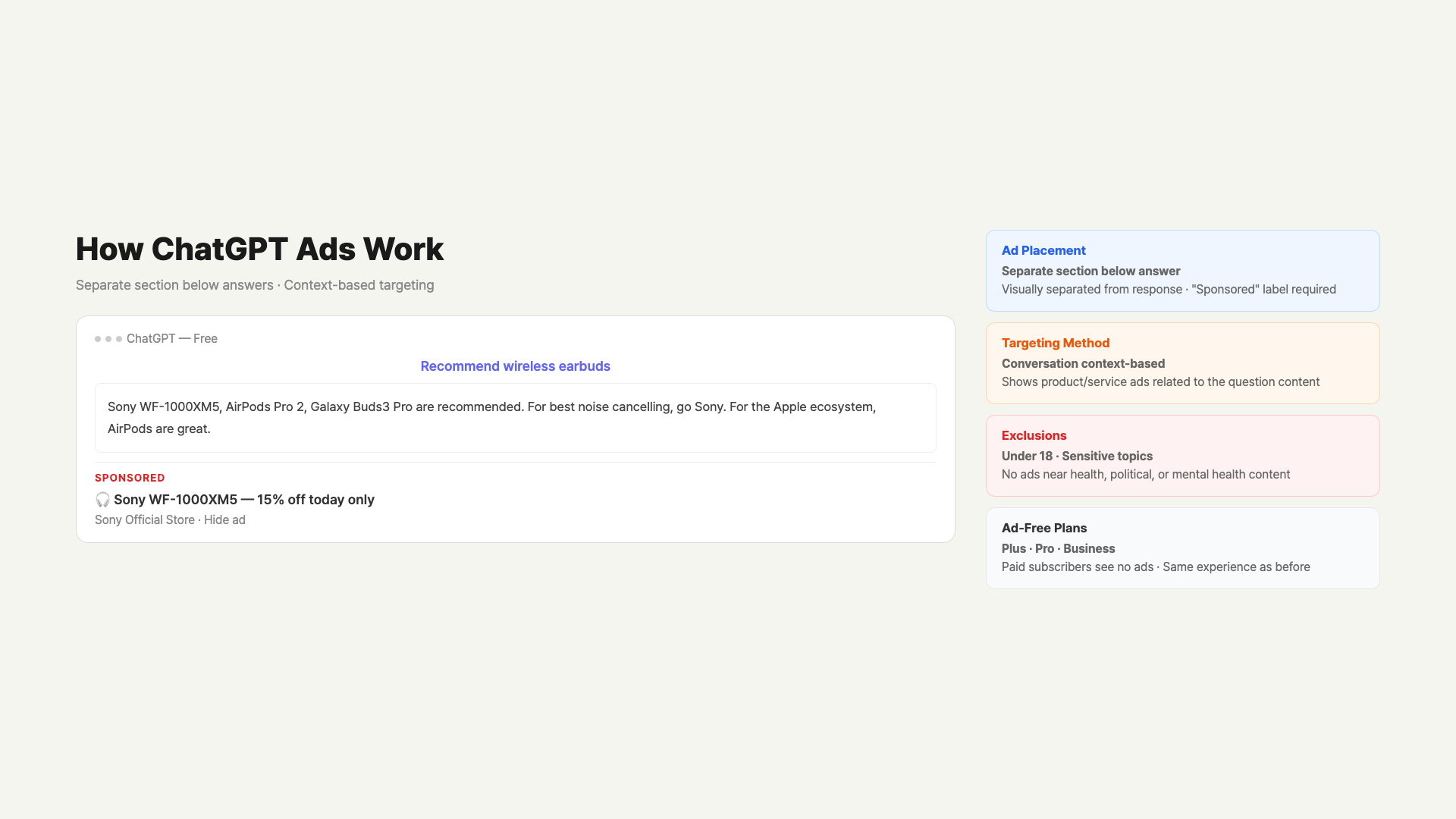
Ad area visually separated from answer content, with conversation context-based targeting / GoCodeLab
What Do the Ads Look Like?
Here’s what’s been disclosed so far. Since it’s still in testing, this could change, but here’s the current known structure.
Ads appear in a separate area below the ChatGPT answer. They’re visually distinct from the answer and always marked “Sponsored.” You’ll see ads for products or services related to your conversation. For example, if you ask “recommend wireless earbuds,” you might see an earbuds brand ad. Ask “plan a trip itinerary” and you might see airline or hotel ads. It’s a contextual ad approach based on conversation context.
Criteo was selected as the ad technology partner. Criteo is globally renowned in e-commerce retargeting advertising. Advertisers can place ads on ChatGPT through Criteo. The CPM (cost per 1,000 impressions) is fixed at $60, and each campaign can register up to 50 products. For reference, typical display ad CPMs run $2-$10, so ChatGPT’s $60 CPM is quite high. Advertisers seem to find it acceptable because the conversion rate justifies it.
Currently only being tested on the mobile app. An ad area appears after certain conversations, and not every conversation gets ads. Ads are more likely to appear in conversations with specific product/service recommendations rather than short, simple Q&As.
What if I don’t want to see ads?
You have several options. Switching to a paid plan (Plus or higher) eliminates ads entirely. You can also opt out of ads while staying on the free plan, but your daily message limit gets reduced. You can individually close specific ads you don’t like or leave feedback, and you can request deletion of ad-related data individually. Complete ad blocking is only possible by switching to a paid plan.
Do Ads Affect the Answers?
OpenAI’s official position is “no.” But whether that’s fully reassuring deserves more thought.
In the current disclosed structure, ads appear in a separate area after the answer is complete. OpenAI stated that advertisers cannot intervene in or modify answer content to favor specific products. Ads are not shown to users under 18, and they don’t appear near conversations about sensitive topics like health, politics, or mental health.
According to Criteo data, users who see ads on AI platforms like ChatGPT convert at 1.5x the rate of traditional display ad channels. For advertisers, it’s quite an attractive channel. The reason is simple: Google Search has intent but no conversation context, YouTube has context but low purchase intent. ChatGPT gets ads placed when specific purchase intent is revealed, like “recommend wireless earbuds,” so conversion rates are naturally higher.
However, we need to watch how this evolves long-term. Right now it’s “a separate area below the answer,” but over time, ads could creep closer to answers or transform into “recommendation” formats. Google initially kept search results and ads clearly separated too, but now top ads often look quite similar to organic results. How ChatGPT ads evolve long-term needs continued monitoring.
What About Paid Users?
Pro, Business, and Enterprise subscribers get no ads. Everything works just as before. This was made explicitly clear in the announcement.
Only Free and Go users are ad targets. Go is a mid-tier plan cheaper than Plus — reportedly around $8-$10/month in the US. The fact that Go plan users are also included as ad targets signals an intent to monetize not just free users but also low-cost subscribers through ad revenue.
Global users can expect sequential rollout after the US completion. No official timeline exists, but based on OpenAI’s global expansion patterns, major countries typically get included within 3-6 months after US-wide adoption. There’s a possibility of rollout in the second half of 2026. If you’re considering upgrading to paid, now isn’t a bad time. Once ads start appearing, the free plan experience will feel different.
Do Other AI Services Have Ads?
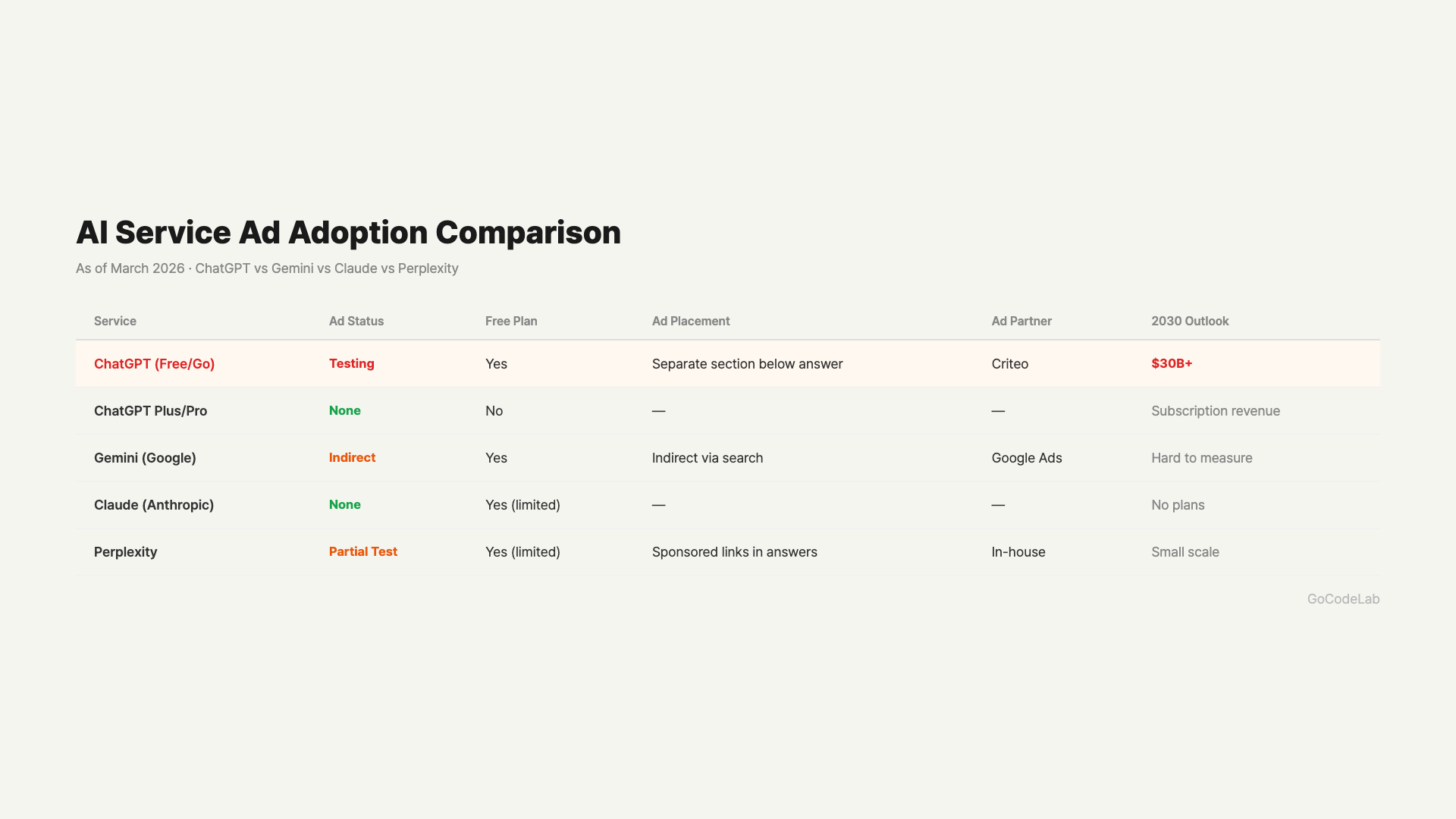
| Service | Ads | Free Plan |
|---|---|---|
| ChatGPT (Free/Go) | Testing since March | Yes |
| ChatGPT Plus/Pro | None | No |
| Gemini (Google) | Indirect via search integration | Yes |
| Claude (Anthropic) | None | Yes (limited) |
| Perplexity | None (subscription-focused) | Yes (limited) |
Each service’s situation is slightly different.
Gemini is structurally hard to separate from ads because Google built it. Currently there are no explicit ads in Gemini responses themselves, but since it’s connected to Google Search and integrated with Google Workspace, there are concerns that ad-like content could have indirect influence. Since Google’s entire business model is advertising, Gemini’s direction could shift over time.
Claude (Anthropic) currently has no ad plans. Anthropic has clear usage standards — even refusing military and surveillance use by policy. They aim for a revenue model based on APIs and enterprise subscriptions rather than ad monetization. Short-term ad adoption seems unlikely. However, Anthropic is also a startup that needs funding, so long-term prospects remain uncertain.
Perplexity has already tested some “sponsored search result” formats. While it aims for a subscription-focused business, it doesn’t completely exclude ads. Given its nature as an AI search engine, it could evolve into something similar to search ads.
In conclusion, ChatGPT’s ad introduction touches on the industry-wide question of “free AI service sustainability.” ChatGPT moved first, but as services scale, other players will face similar dilemmas.
The AI Ad Era — How Should We Adapt?
ChatGPT’s ad introduction signals that AI services have returned to the reality of “there’s no free lunch.” Just like Google, YouTube, and Instagram, it’s the classic platform strategy of gathering users for free then monetizing through ads. Here’s how to respond based on your situation.
If you’re staying on the free plan
Ads themselves may not be a big deal. Like YouTube ads, they’ll likely become something you just skip past once you get used to them. Initially, ad frequency will probably be set low. Showing too many ads before users adapt leads to churn, not upgrades. Starting with a non-intrusive level and gradually increasing is the classic ad introduction pattern.
Right now only 5% of mobile users are in the test, so few people feel the difference yet. But that’ll change after full rollout. Something worth knowing in advance: your conversation content is used for ad targeting. OpenAI says they “don’t share data with advertisers,” but ChatGPT’s internal system analyzing conversations to select ads is structurally inevitable. Your “recommend wireless earbuds” conversation doesn’t go directly to advertisers, but it is used to show earbuds ads. The habit of not putting sensitive personal info or work secrets into conversations becomes even more important for free users.
If you’re considering an upgrade
The ad introduction could be the deciding factor for people on the fence about going paid. No ads, more messages, access to GPT-4o and above, longer context — the practical benefits of switching to Plus ($20/month) are now clearer than ever.
Here’s one benchmark: if you use ChatGPT more than 10 times a day, the paid plan is good value. The more you use it, the more ads you’ll see, and the time and annoyance of skipping them adds up. On the other hand, if you use it just 1-2 times a week, tolerating ads on the free plan may be the more economical choice. Weigh your usage frequency against ad annoyance.
One more thing: the models available on the free plan may become more limited than before. OpenAI is increasingly giving paid plan users first access to the latest models. If you want both no ads and the latest models, moving up your upgrade timeline makes sense.
If you’re using it for work
Business and Enterprise plans are ad-free by default. But that’s not the only reason to use them — the data handling is fundamentally different. Business-tier and above plans don’t use conversation content for model training, and you can control data retention periods. If you’re handling internal company documents, customer data, or strategic information in ChatGPT conversations, the free plan was never the right choice. Not because of ads, but because of security and data policies.
For startups or small teams, the Team plan ($25/month/user) is worth checking out. Slightly more expensive than individual Plus, but it offers team management, data isolation, and no ads. If multiple people are using it, the Team plan is a reasonable choice.
If you ask about an advertised product during a conversation, the advertiser’s product might get priority placement. For example, when you ask “recommend wireless earbuds” and the advertiser’s product appears first — OpenAI’s official position is “no intervention in answer content.” But if the ad area and answer area look similar, it’s worth double-checking. Ads are ads, recommendations are recommendations. Build the habit of distinguishing between them.
FAQ
Q. Will ads reach users outside the US soon?
Currently rolling out in the US only. No official timeline for global deployment has been announced. Based on OpenAI’s existing patterns, full US testing typically completes before expanding to major countries within months. Could reach global markets as early as H2 2026, or early 2027 at the latest. Not a bad idea to consider going paid before then.
Q. Do I have to pay to avoid ads?
Not necessarily. You can opt out of ads while staying on the free plan. However, your daily message limit will be reduced. To use ChatGPT completely ad-free with unlimited messages, a Plus or higher paid plan is required. If you don’t send many messages, the ad opt-out option could work. However, the specific message limits for this option haven’t been officially announced yet.
Q. Could ads lower ChatGPT’s answer quality?
OpenAI officially stated that answers and ads are completely separated. In the current structure, ads are appended below the answer, so the answer itself doesn’t change. But how this evolves long-term needs watching. Google also clearly separated search results and ads at first, but over time, ads began looking like organic results. There’s no guarantee ChatGPT won’t go the same direction.
Q. What is Criteo? Is my conversation data used for ads?
Criteo is an e-commerce retargeting ad company. If you’ve ever browsed a product on an online store and later seen that product’s ad on a different site, that’s likely Criteo’s technology. OpenAI stated they don’t share conversation content with advertisers and don’t sell ad data. Ads are shown based on conversation context, but the raw data isn’t passed to advertisers. However, whether Criteo’s servers receive ad-related logs is still unclear. Be cautious during sensitive conversations.
Q. Will latest models like GPT-5.4 also get ads?
The current ad test targets models available on the free plan. Since GPT-5.4 is only fully available on Plus and above, ads operate within the model range free users can access. Ads will likely appear on GPT-4o mini or base models accessible on the free plan. As the trend of restricting the latest models to paid plans strengthens, you’ll increasingly need a paid plan to access the newest models.
Wrap-Up
Honestly, this decision came faster than expected.
With ChatGPT now used by over 100 million people worldwide, the urge to add ads is a natural progression. Google did it, YouTube did it, Instagram did it. A platform that’s gathered enough users monetizing through ads is the classic formula of digital business. OpenAI following this formula was perhaps an inevitable step.
However, given the nature of AI services, the anxiety that “ads might creep into answers” is real. They say it’s separated for now, but we need to keep watching whether that boundary blurs over time. When Google first added ads, many worried that “search result neutrality would be compromised” — and that concern wasn’t entirely wrong.
There’s no major change for global users just yet. But the signal that AI services are heading toward ad-based business is clear. The era of taking free AI for granted seems to be gradually ending. Which service to use, how much you’re willing to pay, and how far you’ll let your conversation data go — it’s worth thinking about your own answers to these questions in advance.
Thinking about ChatGPT plans? Try the free plan thoroughly before upgrading.
This article was written on March 24, 2026. OpenAI’s ad policies and pricing plans may continue to change. Check the official OpenAI blog for the latest information.
At GoCodeLab, we try AI tools hands-on and share honest reviews. Subscribe to the blog for more AI news.