AI Trends6 min
Meta AI Might Have to Borrow Google Gemini — Avocado Delay Full Breakdown
Meta's next-gen AI model Avocado has been delayed to May or later. Falling behind GPT-5.4 and Gemini 3.1 Pro in performance, a strategic shift from open-source to proprietary, and reviewing Google Gemini licensing — we cover it all.
On this page (8)
March 19, 2026 · Trends
Meta’s ambitious AI model “Avocado” has finally announced a delay. It was originally scheduled for a March 2026 release, but internal testing showed it significantly falling behind competitor models. What’s even more shocking is separate. Meta — which championed “open-source AI is the answer” — is reportedly considering temporarily licensing competitor Google’s Gemini.Quick Summary
What Is Avocado?
Avocado is Meta’s next-generation flagship AI model. It’s a reasoning-focused LLM designed to compete directly with GPT-5, Gemini 3, and Claude 4. Meta announced plans to invest $115-135 billion in AI infrastructure in 2026 alone. That shows just how much was riding on this model internally. Here’s the crucial point. Avocado is Meta’s first proprietary model. Unlike the Llama series, it won’t be released as open source. This represents a complete departure from Meta’s long-held philosophy that “open-source AI is the answer.” Note that Meta also has another model called “Mango” in the works. Mango is a high-quality multimodal world model targeting the generative video market. Avocado handles reasoning, Mango handles video — these two models form the twin pillars of Meta’s AI strategy. The original release target was 2025. That slipped to early 2026, and now it’s been delayed again to May or later. The delay was reported on March 12 through multiple outlets including The New York Times.Why Was the Launch Delayed?
Internal test results fell short of expectations. Specifically, it failed to meet targets in key areas like logical reasoning, coding, writing, and agentic behavior (the ability to autonomously plan and execute complex tasks). Avocado’s current performance reportedly sits above Gemini 2.5 but below Gemini 3 (released November 2025). The problem is that Gemini 3 was released 4 months ago. Launching at this performance level would put it at the level of a competitor’s 4-month-old model.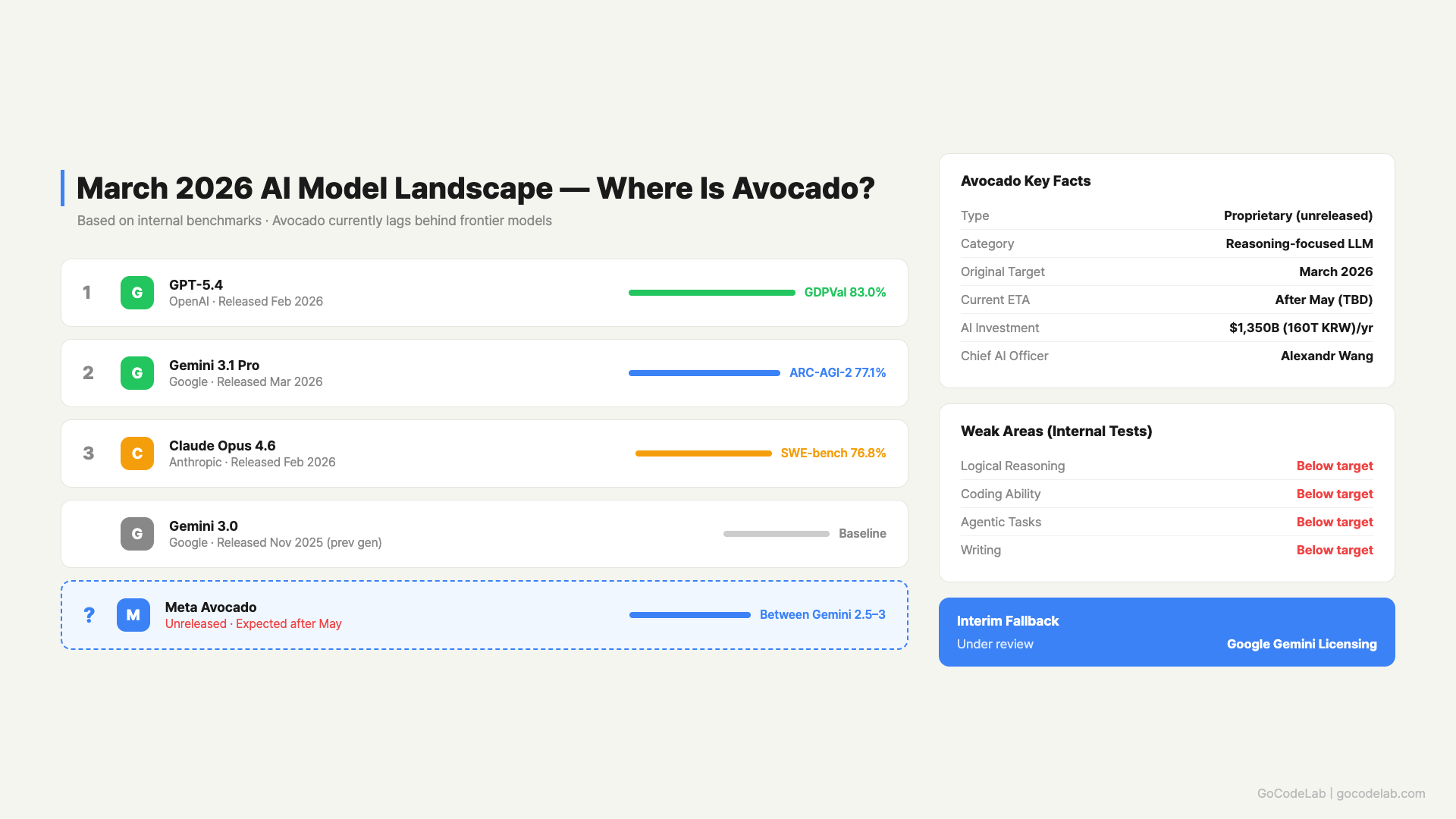 Launching without closing this gap would mean pouring $115+ billion into producing a model that matches a competitor’s release from four months ago.
What Does “Borrowing Google Gemini” Mean?
This is the most unprecedented part. Meta has been the symbol of open-source AI until now. By releasing the Llama series for free, they’ve championed the philosophy that “AI should be open source.” But the leaked news suggests they’re considering temporarily licensing competitor Google’s Gemini technology. The idea is to run AI features across Meta AI app, WhatsApp, Instagram, and Facebook on Gemini until Avocado is ready. Nothing is finalized yet. But the very fact that this discussion is happening shows how desperate Meta’s situation is.Why Did Meta AI Fall Behind?
Industry experts point to several causes. The abrupt shift from open-source to proprietary. Zuckerberg once said “f**k that” about closed platforms and even wrote an internal memo titled “Open Source AI is the Path Forward.” But as they fell behind OpenAI and Google, and AGI safety concerns grew, the stance changed. The switch to making Avocado proprietary created friction between existing open-source research capabilities and the new direction. Major leadership changes. In June 2025, Meta acquired Scale AI founder Alexandr Wang for $14.3 billion, appointing him as Chief AI Officer. Under Wang’s leadership, Meta AI is transitioning from an “open research” era to a “frontier product” company. Reports indicate internal tensions arising from this process. Talent drain. Some key AI research personnel moved to OpenAI and Google DeepMind. Team continuity may have affected research velocity. Trying to pursue three directions simultaneously. Llama series open-source + Avocado proprietary model + Mango video model — pushing all three at once may have spread resources too thin.Meta’s Strategy Shift — Timeline
To understand the Avocado situation, you need to see the full picture of how Meta’s AI strategy has evolved.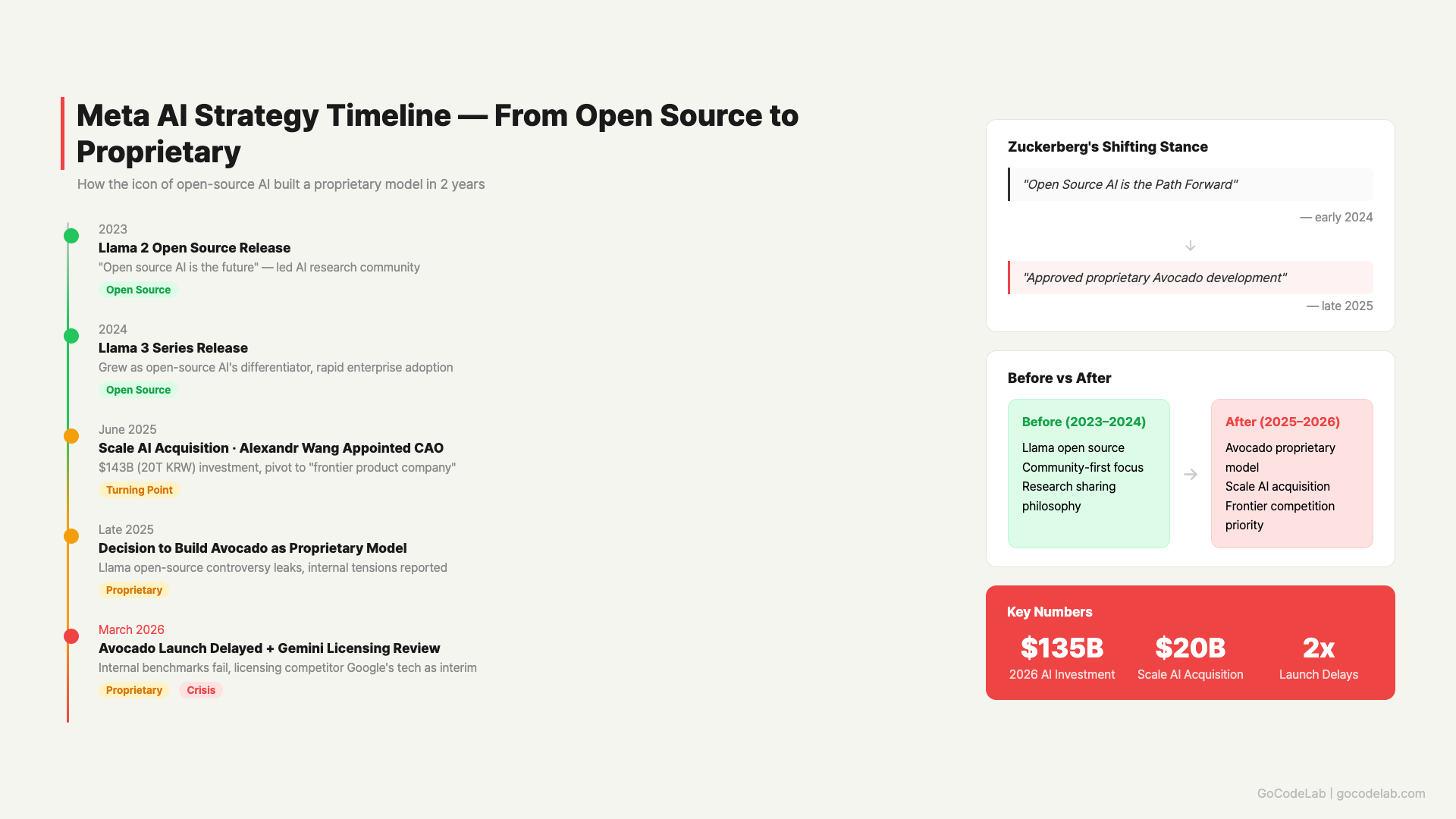 The icon of open source ended up making a proprietary model in just two years. It shows how rapidly the AI race is moving.
Will It Really Launch in May?
The May date isn’t confirmed either. Internal sources phrased it as “May or later.” The possibility of further delays remains open. There’s also a timing issue. OpenAI and Google are relentlessly preparing their next models right now. By the time Avocado launches, even more powerful models may already be out. Still, there’s no reason for Meta to give up. Their annual AI investment of $115+ billion rivals OpenAI and Google combined. The Llama open-source ecosystem remains strong, and strategy could shift depending on how Avocado connects with the Llama 4 lineup.FAQ
Q. What is Meta Avocado?
It’s Meta’s next-generation flagship AI model. A reasoning-focused LLM designed to directly compete with GPT-5.4, Gemini 3.1 Pro, and Claude Opus 4.6. Unlike Llama, it’s a proprietary model, not open source.Q. When will Avocado be released?
It was scheduled for March 2026 but has been delayed to May or later. Given the phrasing “May or later,” further delays are possible. No official date has been announced.Q. Is it confirmed that Meta will borrow Google Gemini?
No final decision has been made. It’s one of the options being considered. The concept is to temporarily power Meta’s consumer apps (WhatsApp, Instagram, Facebook) with Gemini during the Avocado development period. Meta has not officially confirmed this.Q. Can’t I use Meta AI right now?
The Meta AI app and AI features within WhatsApp and Instagram are still available. They currently run on Llama-based models. The Avocado delay doesn’t immediately impact current services.Q. How much is Meta investing in AI?
Meta announced it will invest $115-135 billion in AI infrastructure in 2026 alone. This scale rivals OpenAI and Google combined. While the investment is massive, it hasn’t yet translated into direct results in the model performance race.Q. What is Mango?
It’s another AI model Meta is developing alongside Avocado. A high-quality multimodal world model targeting the generative video market. Avocado handles reasoning, Mango handles video — the two pillars of Meta’s AI strategy.Q. Will Llama stop being released?
The Llama series will continue. However, Meta appears to be adopting a dual strategy: frontier-level top models go proprietary like Avocado, while Llama continues as open source for the community.Wrap Up
The Meta Avocado delay illustrates just how fast and fierce the AI competition has become. Even the world’s largest social media company is a step behind in the current race despite investing $115+ billion annually. That’s precisely why the unprecedented option of licensing Google Gemini is on the table. What’s more worth watching is the growing pains as Meta — which once championed “open-source AI is the answer” — transitions to proprietary models. How quickly Meta AI can bounce back under Alexandr Wang’s leadership — Avocado’s final launch date will be that answer.Want the latest AI competition news? Subscribe to GoCodeLab blog.
Official Sources
This article was written on March 19, 2026. AI model release schedules and licensing discussions are subject to change before official announcements. Check Meta’s official channels for the latest information.
Related: Gemini 3.1 Pro vs Claude Opus 4.6 vs GPT-5.3 Comparison · GPT-5.4 Is Out — What’s Different? · DeepSeek V4 Is Out — Is It Really a GPT-5 Rival?